When a Waterproof Jacket Was Never Waterproof: Coating vs Membrane
As an Amazon Associate we earn from qualifying purchases. This page contains affiliate links — if you buy through them, we earn a small commission at no extra cost to you.
UK consumer law does not require a jacket labelled ‘waterproof’ to have a membrane — a PU coating meets the legal threshold. This regulatory fact explains why two jackets both sold as waterproof can perform so differently after a few seasons.
You’ve just finished a walk in steady UK rain. The path was muddy, your boots are caked, and when you get home and peel off your jacket, it’s heavy, dark, and soaked through. Not drizzle-soaked — properly saturated. You grab the bottle of Nikwax on the draining board and start wondering if you should reproof it, or whether you’re about to spend £15 on a product for a jacket that was never going to work in the first place.
Care cards always assume your jacket is the real thing — a proper breathable shell that just needs maintenance. But what if it isn’t? What if the reason your jacket soaks through isn’t a worn Durable Water Repellent (DWR) finish that you can refresh, but an internal coating that has quietly broken down over the last few years? No amount of Nikwax or Granger’s will bring that back.
That distinction — between a jacket that can be saved and one that was never truly waterproof to begin with — is what this article is about.
Understanding the “Wet Out” Problem
Before anything else, be precise about what “wet” actually means here — the two types are easily confused.
Wetting out happens when the outer face fabric absorbs water. The fibres go dark, the jacket feels heavy, and you feel damp from the inside — but that dampness is often your own perspiration and evaporative cooling, not rain forcing its way through. The membrane underneath may be working perfectly. This is the most common complaint with membrane jackets that have had their DWR worn off by dirt and body oils.
Leaking occurs when water actually passes through the membrane. This is rarer and more serious — it means a seam has failed, the tape has lifted, or the membrane itself is compromised.
It’s a common and avoidable mistake: replacing a jacket you think has failed when the actual problem was just a dead DWR on a perfectly functional membrane. That’s a costly error — a new jacket is a few hundred pounds, while a bottle of tech wash and a wash-in reproofer is roughly £15–£20 combined. Getting the diagnosis wrong means spending money on the wrong problem.
The quick test is simple: when it’s raining, does water bead and roll off some sections while others go dark and stay wet? If beading is patchy but still present in places, the membrane is likely fine and you’re looking at a DWR refresh. If the whole face fabric soaks in uniformly and stays saturated, you’re deeper into the problem — and it might not be a care issue at all.
Coating vs Membrane: The Core Difference
There are two fundamentally different ways a jacket can claim to be waterproof. One is a membrane. The other is a coating. They sound similar; they are not.
A membrane — Gore-Tex, eVent, Pertex Shield, HyVent — is a separate physical layer bonded to or laminated inside the face fabric. It has microscopic pores that are small enough to block liquid water droplets from the outside but large enough to let water vapour (your sweat) escape from the inside. The membrane itself does the waterproofing work, and it doesn’t degrade the way coatings do. The DWR on the outside is there to keep the face fabric beading so the membrane’s pores don’t get flooded and blocked — it’s a surface treatment, not the waterproof barrier.
A PU coating is exactly what it sounds like: a layer of polyurethane painted or coated onto the inside of the face fabric. It acts as a waterproof barrier, but it is not bonded as a separate membrane; it is part of the fabric itself. Here is the problem: PU coatings degrade via hydrolysis. Over time, moisture and warmth cause the polyurethane to break down, delaminate, and lose its waterproofing properties. This typically happens over two to five years according to fabric industry sources, and once it starts, it cannot be reversed. No wash, no reproofer, no heat treatment can restore a coating that has hydrolysed.
The honest reality is that many budget waterproof jackets use a PU coating rather than a membrane. They aren’t lying; the coating does provide some water resistance. But “water-resistant with a coating that will degrade over a few years” is not the same as a genuinely waterproof membrane jacket designed to last a decade or more with proper care.
The crucial insight: once a PU coating has degraded, no reproofer on the market can restore the waterproof barrier. Reproofers work on the DWR surface — the outermost hydrophobic coating. They sit on top of the face fabric. They cannot reach through a failed coating to fix the layer beneath it. If the waterproof barrier itself has broken down, you’re not reproofing — you’re putting a new coat of paint on a house with a cracked foundation.
A membrane jacket that has wet out because its DWR is worn needs a tech wash and a reproof, and it can carry on for years. A coated jacket where the coating has gone is looking at replacement. That is the distinction that saves you money, and it’s the distinction most care cards have no interest in making.
Can a Coated Jacket Be Repaired?
In most cases — and this is the honest answer — once a PU coating has degraded, it cannot be restored to its original waterproof state. The chemistry does not exist in any consumer product to rebuild a polyurethane layer that has broken down via hydrolysis. This is not a case of the wrong product or insufficient application; it is a physical and chemical change in the material itself.
What a reproofer can do on a coated jacket is marginally improve how the face fabric handles water at the surface. If the face fabric still has some integrity, a DWR treatment might make it bead a bit better for a short period. But that is surface behaviour, not a restored waterproof barrier.
Spending £30 on a wash-in reproofer for an old budget jacket and still getting soaked in moderate rain isn’t evidence of a bad product. It’s evidence of a jacket that was never going to be saved by that route. The proofer was never the fix because the problem wasn’t the DWR.
There are rare exceptions. Some technical fabrics use coatings that have been engineered to be more durable or that can accept reproofing in specific conditions. But these are not common in the budget-to-mid-price range. For the vast majority of coated jackets bought for £40–£60 a few years ago, replacement is the answer once the coating has gone.
If you’re holding a bottle of TX.Direct or Granger’s Performance Repel and wondering whether to use it on a jacket that’s three or four years old and came from the budget end of the range, the question to ask first is not what product to use — it’s whether the jacket has a coating that has already degraded past the point where any product can help.
Identifying Your Jacket Type
The good news is you don’t have to guess. There are three practical ways to work out which type of jacket you’re dealing with.
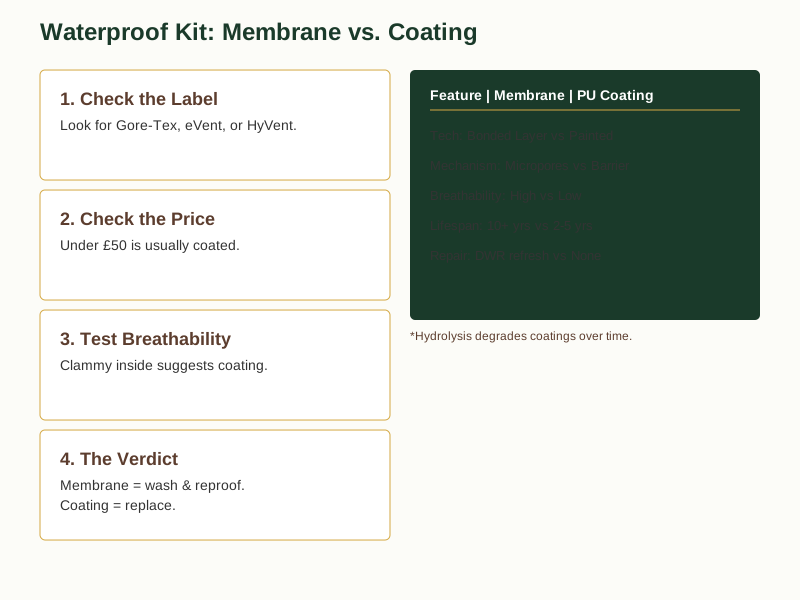
Check the label. This is the most direct route. Look for brand names: Gore-Tex, eVent, Pertex Shield, HyVent, Dermizax. These are membrane technologies. If the label says “waterproof” with no named membrane technology and no mention of breathability, that’s a yellow flag. Many coated jackets are marketed as “waterproof” without naming a specific membrane — they technically are, in the sense that they resist water for a period, but the mechanism is the coating, not a membrane.
Consider the price point. This is general market practice, not a hard rule, but the pattern is consistent. Budget jackets are more likely to be coated, while premium jackets typically feature membranes. The mid-price band is mixed — some genuine membranes appear there, particularly from brands selling older stock, but it’s also where coated jackets sit with upgraded marketing.
Test the breathability. Put the jacket on during a brisk walk. If the inside feels clammy and damp even in cool conditions, and you’re not working particularly hard, that’s consistent with a coating rather than a membrane. Membranes are designed to move vapour; coatings resist water but don’t manage heat and moisture the same way. This is a rough test, but combined with the label check, it gives you a solid picture.
If your jacket has a named membrane technology and was in the higher price bracket when bought, it is almost certainly worth washing and reproofing before replacing. If it’s from the budget end, came without a named membrane, and is three or more years old, the odds of the coating having degraded are significant enough that you’d be better off budgeting for a replacement than spending on products that can’t fix the underlying problem.
Jacket Type Comparison
| Feature | Membrane | PU Coating |
|---|---|---|
| Technology | Separate bonded layer (e.g., Gore-Tex) | Painted onto fabric |
| Waterproof Mechanism | Micropores block water | Solid barrier |
| Breathability | High | Low |
| Lifespan | 10+ years with care | 2–5 years before hydrolysis |
| Repairability | DWR refresh possible | Cannot be restored once degraded |
Common Questions Answered
Can I put a membrane jacket in the washing machine?
Yes — most modern membranes including Gore-Tex are machine washable at around 30–40°C according to GORE-TEX care instructions . Use a dedicated tech wash like Nikwax Tech Wash (paid link) or Granger’s Performance Wash (paid link), and avoid fabric softener and powder detergents entirely. After washing, tumble dry on a warm cycle to reactivate the DWR, or if the care label says not to tumble dry, line dry and then tumble for 20 minutes on warm. Gore’s own care instructions make this sequence explicit: wash, dry fully, then heat-activate.
Check Granger’s Performance Wash price → (paid link)
Buy Nikwax Tech Wash on Amazon → (paid link)
My jacket smells after washing. Is something wrong?
Not necessarily. Tech jackets trap body oils and sweat in the fabric over time, and ordinary detergent often doesn’t remove these effectively. A dedicated tech wash is formulated for this. It’s one of the reasons specialists like Nikwax Tech Wash (paid link) exist rather than using whatever’s already under the sink. If the smell persists after a proper tech wash, the jacket may be at the end of its usable life rather than just dirty.
Is it worth reproofing an old jacket?
If the jacket has a membrane and the DWR is simply worn off, reproofing is genuinely worth doing — it can extend the life of a sound membrane jacket by a year or two for the cost of a bottle. If the jacket has a PU coating that has degraded, reproofing won’t work, and you’d be better off putting that money towards a replacement. The question isn’t “is the jacket old?” — it’s “does the jacket have a membrane that’s still intact?”
Most jackets can be divided into two groups: ones with a membrane that can be refreshed with a tech wash and a reproofer, and ones with a coating that has either already degraded or will within a few years and cannot be saved by any product on the market. If you own a budget jacket from a few years ago and it’s started soaking through, the honest answer is that the care products on your draining board may not be the fix you’re looking for.
What you need first is the diagnosis. Check the label. Note the price you paid. Ask whether the jacket ever breathed the way a proper membrane jacket should. Once you know which category you’re in, the path forward becomes obvious — either care for the jacket you have, or start thinking about what comes next.
You can distinguish a coated jacket from a membrane jacket without cutting it open by checking the internal lining texture — coated jackets often have a slightly rubbery feel when you rub the fabric between your fingers.
If you’ve worked out it’s a membrane jacket worth saving, the next step is straightforward: a proper tech wash, a wash-in reproofer, and a heat activation cycle. Grab the Free Waterproof Care Checklist — it walks through the full wash-then-reproof sequence step by step, with the product order that actually works and the mistakes most people make without realising.
Related Guides
For membrane-specific guidance, see our Why Waterproof Jackets Wet Out (and What to Do Instead of Buying a New One) .
References
As an Amazon Associate we earn from qualifying purchases.
Note: General guidance only, verify details with a qualified professional or official source.