When to Reproof vs When to Replace a Waterproof Jacket
As an Amazon Associate we earn from qualifying purchases. This page contains affiliate links — if you buy through them, we earn a small commission at no extra cost to you.
Waterproof jacket failure splits into two clear classes: surface DWR wear, which is maintainable, and membrane damage, which is not. Understanding this distinction saves you from replacing jackets that still have years of life left.
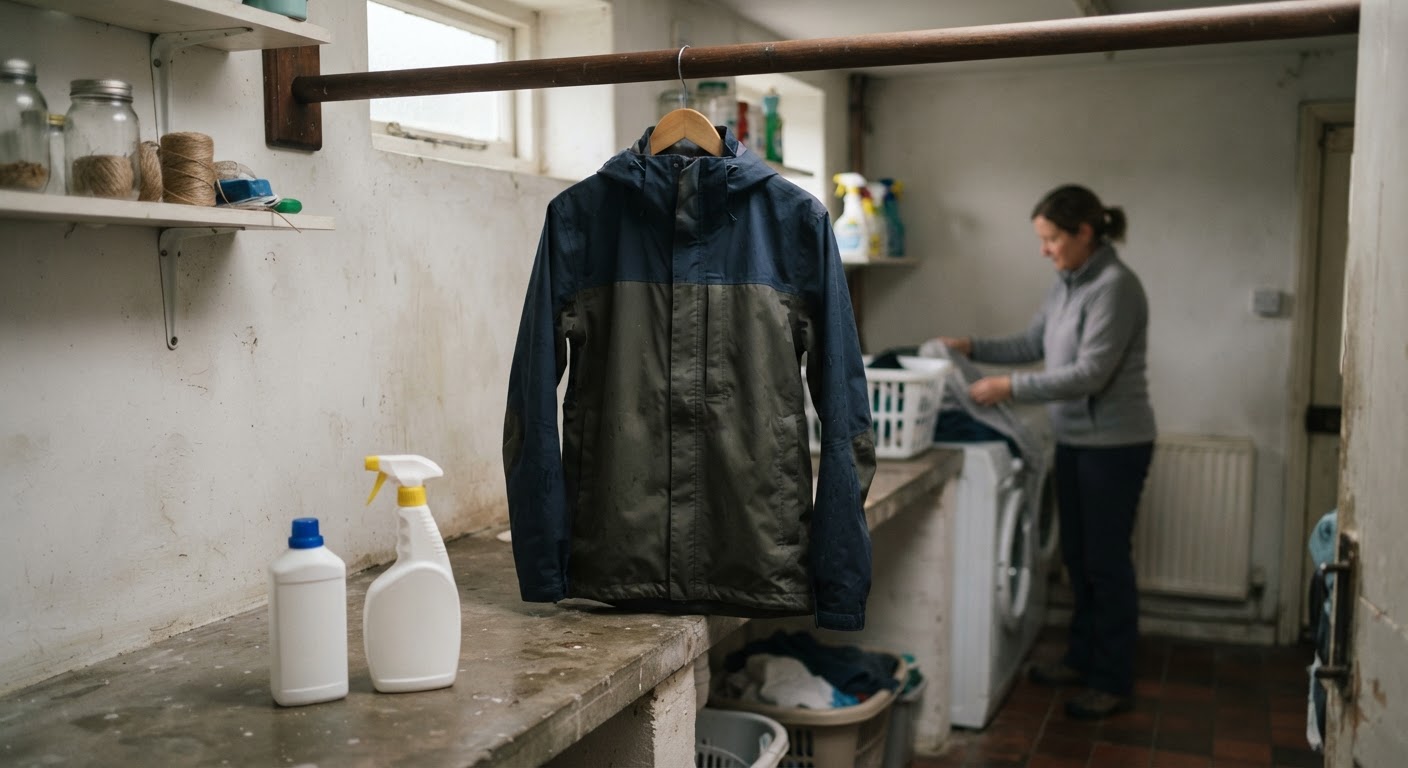
Your jacket looks dark and soaked after twenty minutes in the rain. You can feel the damp working through, and your first thought is that the membrane has given up. Before you spend hundreds on a replacement, there’s something worth knowing: the face fabric soaking through and the membrane failing are two completely different problems.
What you’re most likely looking at is a failed Durable Water Repellent (DWR) coating—the outer layer that makes water bead and roll off. That coating wears out over time, and when it does, water soaks into the face fabric instead of beading. The honest answer is that most wetting-out is fixable with a specialist wash and a bottle of DWR proofer, not a trip to the retailer.
This article gives you the diagnostic you need to tell the difference, and the cost-benefit framework to decide which route makes sense for your jacket.
Understanding the Two Failure Types
The confusion here comes from not knowing there are two separate systems doing different jobs inside your jacket.
The DWR coating is a thin chemical layer applied to the outer face fabric during manufacture. Its sole job is to make water bead up and roll off before it even reaches the fabric underneath. DWR is sacrificial by design—manufacturers know it wears off with use, which is why proofer products exist. When DWR goes, water stops beading and starts soaking into the face fabric instead. This is what people mean when they say a jacket has “wetted out.”
The membrane is the structural waterproof layer beneath the face fabric—the Gore-Tex, eVent, or proprietary equivalent that actually stops liquid water from passing through while still allowing sweat vapour to escape. The membrane doesn’t wear out from rain or washing. It fails from physical damage: delamination (the inner layer peeling away from the face), punctures, worn-through areas at high-abrasion points like shoulders and elbows, or seam tape that has let go.
The key diagnostic point is this: when the face fabric is soaked but the inside of the jacket stays dry, the membrane is still working. That’s DWR failure, not membrane failure. You see water soaking into the shoulders after twenty minutes of rain, but the inside is still keeping the rain out. That is the wetting-out pattern, and it is fixable.
When the inside gets wet—not from condensation, not from sweat, but from water pushing through from outside—that is a membrane or seam failure, and the fix is different.
The Cost-Benefit Case for Reproofing
A new Gore-Tex jacket represents a significant investment, while the cleaning and reproofing combination—a tech wash and a matching wash-in DWR proofer—costs substantially less. Current UK listings show Nikwax Tech Wash priced around £4.99–£17.99, with DWR proofer adding a similar amount.
The economics become clearer when you consider maintenance over time. A jacket that needs reproofing periodically will cost far less to maintain than replacing it outright. Many owners report extending a jacket’s functional life by several years through regular washing and reproofing at a fraction of replacement cost.
The one situation where replacement wins outright is when the membrane is genuinely damaged—delamination, worn-through fabric, seam tape failure. Reproofing cannot fix any of those. But for the far more common scenario of a jacket that is wetting out but still keeping rain off the inside, reproofing is the answer.
How to Make the Call: Physical Inspection
This decision rests on a straightforward physical inspection once you know what to look for.
Replace the jacket if you find any of the following:
- Delamination — the inner liner is visibly peeling away from the face fabric, often seen as bubbling, wrinkling, or a layered feel when you run your hand inside the jacket. Once the membrane has separated from the face, it cannot be rebonded.
- Worn-through areas — thin spots or holes where the fabric has worn down to the membrane or beyond, typically at the shoulders, elbows, and cuffs from pack straps and general use. If light passes through when you hold the fabric up, the membrane is exposed and compromised.
- Seam tape failure — tape lifting or peeling at the seams, or visible leaks along stitch lines even after the jacket has been cleaned and dried. Seam tape is applied at the factory and cannot be reliably re-applied at home, though a sealant like Gear Aid Seam Grip WP (paid link) can patch individual pinholes.
Check Gear Aid Seam Grip WP price → (paid link)
- Brittle fabric — an older jacket where the face fabric feels stiff, papery, or has a pronounced crackle sound when flexed. Membranes degrade over time, and once the fabric itself has begun to break down, reproofing cannot restore structural integrity.
Reproof the jacket if you find only this:
- Wetting out of the face fabric — water soaks into the outer surface, the jacket looks dark and damp, but the inside stays dry. This is the DWR pattern. The membrane is doing its job; the face fabric has stopped shedding water.
There is one more scenario worth naming: condensation. If the inside of your jacket feels damp during exertion but the outside face fabric is still beading, that is sweat and moisture from your clothing layers hitting a cold inner surface—not a waterproofing failure at all. Better base-layer management and jacket ventilation, not a new shell or a reproofer, is the fix here.
For the jacket that falls into the reproofable category—a jacket that is structurally sound, with no delamination, no worn-through areas, and no seam failures—the answer is clean it, treat it, and dry it. Not a new jacket.
The Right Way to Reproof
The order matters here, and skipping the first step is where most reproof jobs go wrong.
Step 1 — Wash first. Use a specialist performance cleaner—Nikwax Tech Wash (paid link) (1 L)—not ordinary detergent.
Check Nikwax Tech Wash price → (paid link)
Granger’s Performance Wash (paid link) (1 L) is the other specialist bottle. Household detergents, particularly powder formulas and fabric softener, leave residues that actively block a new DWR from bonding to the fabric. The care label on your Gore-Tex jacket will confirm this: machine wash at around 40°C with a liquid detergent only, no fabric softener, no bleach, no stain remover.
Buy Granger’s Performance Wash on Amazon → (paid link)
Step 2 — Apply DWR treatment. After the jacket is clean and still damp, apply a wash-in or spray-on DWR proofer. Nikwax TX.Direct (paid link) (1 L wash-in) gives more even coverage across a full jacket.
Check Nikwax TX.Direct price → (paid link)
Nikwax TX.Direct Spray-On (paid link) (300 ml) is useful for targeted treatment on worn shoulder and hood panels.
Check Nikwax TX.Direct Spray-On price → (paid link)
Granger’s Clothing Repel (paid link) (300 ml wash-in) is the practical wash-in alternative.
Check Granger’s Clothing Repel price → (paid link)
Granger’s Performance Repel Plus (paid link) (500 ml spray-on) is the spray alternative. Owners report they revive beading on already-clean shells, though the results are less dramatic on heavily degraded DWR.
Buy Granger’s Performance Repel Plus on Amazon → (paid link)
Step 3 — Tumble dry warm. This is not optional. Low-to-warm heat reactivates the DWR after application, helping it bond properly to the fabric. If you don’t have a tumble dryer, a warm, well-ventilated airing cupboard for a day or two will help, but the dryer does the most effective job of reactivation. Gore’s own care guidance confirms tumble drying at low heat as the recommended method for reactivating DWR after cleaning.
One caveat: if the jacket is old—several years of heavy use, stored badly, or showing signs of fabric degradation—reproofing may give only partial results. DWR products can restore beading to a fabric that still has some coating left to bond with, but they cannot compensate for a membrane that has genuinely aged. That is where the physical inspection in the previous section earns its keep.
Common Questions Answered
Can I put my waterproof jacket in the tumble dryer?
Yes—most modern Gore-Tex and membrane jackets recommend tumble drying on a low-to-warm heat setting. The heat helps reactivate the DWR coating after cleaning or reproofing. Just avoid a high heat setting, and check the care label first if your jacket has one.
Does fabric softener ruin waterproof jackets?
Yes. Fabric softener leaves a waxy residue that clogs the membrane and actively prevents DWR from bonding to the face fabric. Manufacturer guidance consistently advises against using fabric softener on waterproof outerwear.
How often should I reproof my jacket?
Reproof when you notice water stopping its bead and starting to soak into the face fabric. Heavy users might need treatment every few months, while occasional walkers can often go much longer between applications.
Waterproof Jacket Failure Types
| Failure Type | Visual Signs | Fix Required |
|---|---|---|
| DWR Failure | Water soaks into face fabric, jacket looks dark | Wash and reproof |
| Delamination | Inner liner peeling or bubbling | Replace jacket |
| Worn-through | Thin spots or holes at shoulders/elbows | Replace jacket |
| Seam Tape Failure | Tape lifting or leaks along stitch lines | Replace jacket |
| Condensation | Damp inside during exertion, outside beading | Ventilation adjustment |
This table is for illustrative reference only. Always consult the specific care label of your garment.
Making the Final Decision
The short version: if the membrane is intact, the jacket needs cleaning and a new DWR coat, not replacement. That is true whether you spent £100 or £300 on it. DWR is a consumable layer, and reapplying it is exactly what the products are designed for.
What matters is knowing which category your jacket falls into before you spend. Two physical signs make replacement rational: visible delamination or bubbling, or a non-seam puncture that lets water through under light pressure. A jacket that looks dark and soggy but keeps the rain off the inside is a wash-and-reproof job.
If you are not sure which category your jacket falls into, work through the physical checklist above before you buy anything. That inspection can save you from unnecessary replacement costs.
To help you work through the full diagnostic, grab the Free Waterproof Care Checklist—it walks you through every check you need to make, from face fabric condition to seam inspection.
Related Guides
For a complete overview, see our Why Waterproof Jackets Wet Out (and What to Do Instead of Buying a New One) .
Sources & Further Reading
As an Amazon Associate we earn from qualifying purchases.
Note: General guidance only. Always verify specific care instructions with the manufacturer of your garment.