Can Your Down Jacket Survive a Sour Wash? (The Real Reason It Smells)
As an Amazon Associate we earn from qualifying purchases. This page contains affiliate links — if you buy through them, we earn a small commission at no extra cost to you.
Bacteria can start colonising incompletely dried down clusters within a day or so at room temperature. Rewashing without correcting the drying process simply reseeds the same bacteria, trapping you in a cycle of odour that detergent changes won’t fix.
You might pull the jacket from the machine, check the care label, and hang it on the airer. Two days later, the outside feels dry, but pushing your hand into the baffle reveals a faint dampness at the core—and underneath, a stale, musty smell. The jacket looks clean but smells like something from the back of a damp cupboard. This isn’t about soap residue; it’s about moisture trapped where you can’t see it.
The Microbiology of Moisture Trapping
The sour odour often results from trapped moisture and microbial growth. Down’s natural structure means it can retain water long after the outer shell feels dry. In that warm, damp environment, microbial activity produces volatile compounds that create a sour, “wet dog” smell.
This pattern is well-documented in down care, which is why the smell can persist through multiple rinses—you’re diluting soap, not addressing the moisture trapped deep within the fill. The odour is biological, not chemical residue.
Incomplete drying is the primary cause of post-wash odour. While care labels might simply say “hang to dry,” without heat and mechanical agitation to fluff the clusters apart, the inside of thick baffles can stay damp for extended periods.
The Detergent Decision That Compounds the Problem
Since trapped moisture is the root cause, your detergent choice matters. Ordinary household detergents often leave surfactants that hold moisture against fibres. On down, these residues create the exact damp, warm environment that microbes thrive in.
Fabric softener actively ruins down performance by coating the clusters and impeding drying—the opposite of what you need. Most down jacket care labels explicitly ban fabric softener for good reason.
Instead, use a technical down wash like Nikwax Down Wash Direct (paid link) or Granger’s Down Wash (paid link), formulated to clean without leaving wettable residues. Owners who use these consistently report better loft retention and less clumping, which helps the fill dry more evenly.
Check Granger’s Down Wash price → (paid link)
Check Nikwax Down Wash Direct price → (paid link)
Common washing mistakes that increase odour risk:
- Using regular detergent at normal concentration
- Adding fabric softener
- Skipping the extra rinse cycle
- Storing in sealed bags before fully dry
If you’re already dealing with the smell, focus on drying rather than rewashing. More water exposure before proper drying just extends the problem.
Restoring Your Jacket Through Proper Drying
Proper drying requires heat and mechanical agitation to force moisture out of the down clusters. Drip-drying alone rarely suffices for densely-filled winter jackets, especially in UK conditions. A tumble dryer is your most reliable tool.
Always check the care label first. Many reputable brands permit low-heat tumble drying—typically around 30°C, not the cotton cycle. If the label prohibits tumble drying, consider whether ignoring that instruction is worth the risk to your jacket.
Set the dryer to 30°C and add two or three clean tennis balls. They bounce around, physically knocking the down clusters apart as the jacket tumbles—crucial for getting air into the centre of each baffle. Without them, down clumps and stays wet in the middle while the outer layer feels dry.
Run the cycle for at least four hours, checking every thirty minutes. Reach into the centre of main and arm baffles with your fingertips, feeling for consistent texture: light, fluffy, with no dampness. Heavier winter jackets may need multiple cycles before the core is completely dry.
The smell diminishes as microbial activity ceases in the dry heat. Once the fill is fully dry and the tennis balls have restored loft, the sour note should disappear. Persistent odour after thorough drying suggests heavier bacterial load, possibly from prior damp storage or leaving the jacket in the washing machine overnight.
Without a tumble dryer, line-drying in a cool, well-ventilated space over several days can work in warm, dry conditions. The critical test remains verifying that the centre of baffles is dry—if you can’t feel it, assume it isn’t.
Assessing Water Repellency After Drying
Once dry and odour-free, check if the jacket still beads water properly. The DWR coating on the outer fabric degrades with use and washing regardless of odour issues.
If water still beads, the jacket is structurally sound. A common wash-in DWR product like Nikwax TX.Direct (paid link) can restore water repellency without affecting loft. Results may not match factory-fresh performance on older gear, but they genuinely extend usable life.
Check Nikwax TX.Direct price → (paid link)
If the face fabric soaks through completely and fresh tech wash plus DWR treatment doesn’t restore beading, the membrane or coating has likely degraded. At this point, reproofing is insufficient and replacement becomes the practical choice.
The economic calculation is clear: reproofing represents modest investment for seasons of additional use, while replacement involves significantly higher cost. Proper drying before DWR assessment ensures you make the right decision.
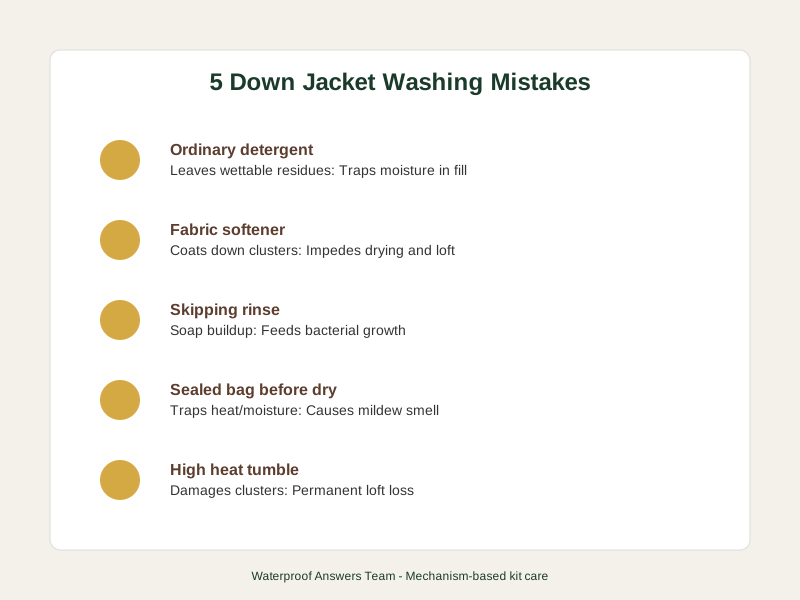
Common Down Jacket Care Errors
| Mistake | Consequence |
|---|---|
| Ordinary detergent | Traps moisture in fill |
| Fabric softener | Impedes drying and loft |
| Skipping rinse | Feeds microbial growth |
| Sealed bag before dry | Causes mildew smell |
| High heat tumble | Permanent loft loss |
Answering Your Down Jacket Questions
Can I use a tumble dryer for my down jacket?
Yes, if the care label permits. Use a low heat setting of 30°C with two or three tennis balls to fluff the down. Check every thirty minutes and run additional cycles if any part feels damp. Avoid high heat settings to prevent damage to the down clusters.
Does vinegar eliminate sour smells?
Vinegar may temporarily mask surface odour but doesn’t penetrate to the down core where microbial growth occurs. It addresses symptoms rather than causes. Complete drying throughout all baffles is the only reliable solution—until moisture is gone, microbes will continue producing the sour note.
What’s the right washing frequency for down jackets?
Typically once a season, or when visibly dirty or odorous. Each wash cycle stresses the down, so avoid excessive washing. In cold, dry conditions, you might stretch to two or three seasons between washes. For regular UK winter use, annual washing is often sufficient.
The essential insight: sour smell after washing indicates moisture remains trapped in the fill, allowing microbial growth. The solution isn’t more detergent but proper low-heat tumble drying with tennis balls until every baffle centre is genuinely dry.
For a straightforward checklist covering washing and drying down jackets and sleeping bags—including steps that commonly undermine results—the free guide provides clear guidance.
Now you understand the cause and the precise correction—Get the Free Waterproof Care Checklist .
Further Reading
For comparison with other outdoor gear care, see Down Jacket vs Waterproof Shell: Why the Wash Is a Different Job .
References
As an Amazon Associate we earn from qualifying purchases.
Note: General guidance only, verify details with a qualified professional or official source.