Wetting Out vs Failed Membrane vs Condensation: How to Tell the Difference
As an Amazon Associate we earn from qualifying purchases. This page contains affiliate links — if you buy through them, we earn a small commission at no extra cost to you.
Three distinct locations tell the story. Moisture on the face fabric—the outer shell that should bead rain—means DWR failure, the coating that repels water has worn away. Moisture on the lining, the layer pressed against your clothes, points to membrane failure, the waterproof barrier itself breached by damage or age. Moisture in the interior air, the space between your skin and the shell, is condensation, warm vapour hitting cold fabric and turning back to liquid. Each location demands a different fix. This article maps how to read them.
The Three Types of “Wet” Gear
Before getting into the tests, it helps to understand what you’re actually dealing with. The sensation is the same for all three; the cause is not.
Wetting out is a face-fabric problem. The outer layer of your jacket—the one that should bead water—has become saturated. This is DWR failure. The Durable Water Repellent coating on the face fabric has worn off or been clogged by detergent residue and body oils, so it no longer repels water. The fabric soaks in and goes dark. Water hasn’t got through your membrane yet, but the face fabric is acting like a sponge, and that saturated fabric against your skin feels exactly like leaking. The fix is washing and reproofing—nothing structural has failed.
Membrane failure is structural. The waterproof and breathable layer itself has been breached. Water gets through—not because the face fabric is saturated, but because the barrier underneath has a hole, a delamination, a lifted seam tape, or damage from abrasion, age, or solvent exposure. The inside of the jacket feels wet. Water may be entering at specific points rather than uniformly. The fix is a repair or replacement—washing won’t touch this.
Condensation is a temperature problem. Your body generates water vapour, which passes through the membrane (that’s the breathable part working normally). When that vapour hits the cold outer face fabric, it cools and re-condenses back into liquid water. The inside of the jacket feels damp. The outside may still be beading. Condensation is often worse in cool, humid conditions, when the shell temperature drops below the dew point and the membrane is at its coldest. The fix is improving ventilation or managing exertion—not a new jacket, not reproofing, not a wash.
This distinction is a common source of confusion. It’s understandable—all three make your jacket feel damp. But the fix couldn’t be more different, and the wrong fix wastes money either way.
How to Tell the Difference: The Diagnostic Tests
Here’s where it gets practical. Two straightforward tests will separate the three most of the time.
The inside versus outside check. This is the first thing to establish. Strip the jacket off (or at least open it up) and feel the inside surface. Is the inside wet while the outer face fabric is still shedding water from the rain? That’s condensation—the membrane has done its job, the water is forming on the inside. Is the outside face fabric dark and saturated uniformly, even though you can see water still beading in a few cleaner patches? That’s wetting out—the DWR has failed but the membrane is probably intact. Is water entering at specific points—under the arms, at the shoulders where pack straps rub, along a seam? That’s membrane failure, likely seam tape lift or abrasion damage to the membrane itself.
The shower test. If you’re still unsure, take the jacket somewhere you can spray it with water—a garden hose or shower is fine. Spray the outer face fabric and watch what happens. Water beads and rolls off cleanly? The DWR is working. The fabric darkens and absorbs water across the whole panel? DWR failure, i.e. wetting out. Water gets through to the inside at particular points but the rest stays dry? Structural failure—you’ve found the leak.
The squeeze test. A quick confirmation for suspected membrane failure. Lay the jacket flat, fold it so the suspected leak point is between your palms, and squeeze hard. If water squirts or drips through from the outside, you’ve confirmed a breach. A little surface dampness from condensation is different from pressure-forced ingress—the shower test is more reliable for condensation versus rain penetration.
One thing worth knowing: condensation from exertion and pack contact shows up on the inside of the jacket but typically doesn’t saturate the face fabric. If the inside is damp but the outside is still visibly beading, condensation is the most likely cause—particularly if you’ve been working hard or carrying a pack that restricts airflow across your back. Pack contact and high exertion are widely reported as the two biggest contributors to internal condensation, and they’re also the two easiest things to manage without buying anything new.
Why Getting It Wrong Costs You Money
The cost of misdiagnosis isn’t abstract.
If you treat condensation as DWR failure, you’ll wash and reproof the jacket, feel briefly optimistic, and discover the dampness returns the next time you exert yourself in cool, humid conditions. The proofer is not the fix for a temperature and ventilation problem. You’ve spent money and effort on the wrong solution, and the jacket wasn’t the problem to begin with.
If you treat DWR failure as membrane failure, you’ll buy a new jacket. The old one was structurally sound—a wash with a proper technical wash (Nikwax Tech Wash (paid link) or Granger’s Performance Wash (paid link), both widely praised for removing the oils and grime that block the face fabric) followed by a DWR refresh would have restored it. A significant outlay avoided with a modest bottle and a machine wash. This is the misdiagnosis that costs the most, and it’s also the most common one—many owners assume the membrane has gone when the face fabric has simply stopped beading.
Check Granger’s Performance Wash price → (paid link)
See Nikwax Tech Wash on Amazon → (paid link)
The other direction—treating a genuine membrane failure as DWR failure—is less expensive but equally frustrating. You reproof the jacket, the beading returns on the outer fabric, and then it still leaks because the problem is structural. Seam tape lift, delamination, and abrasion damage to the membrane won’t respond to any proofer, no matter what the bottle claims.
There’s also a subtler version of this mistake: reproofing a dirty jacket. If you apply DWR over a face fabric that’s still loaded with sweat oils and grime, the new coating bonds to the contamination rather than the fabric. The result is patchy beading at best, and you’ve wasted the proofer. The standard advice—wash first, then reproof—exists precisely because of this. It’s also why the care label and the proofer bottle both say it, even if they’re saying it for slightly different commercial reasons.
Fixing the Right Problem
Once you’ve identified which type of wet you’re dealing with, the fix is usually straightforward.
For condensation: this is about managing the conditions that create it rather than the jacket itself. Open up the jacket’s zips and vents to improve airflow when you’re exerting hard. Adjust your pack so it doesn’t create a completely airtight seal against your back—a bit of airflow across the shell makes a meaningful difference to internal humidity. If you’re doing a high-output activity in cold, humid conditions, a wicking base layer makes a real difference too, because it moves moisture away from your skin before it reaches the membrane. None of this requires buying a new jacket.
For DWR failure: wash the jacket first with a dedicated technical wash—Nikwax Tech Wash (paid link) is frequently paired with their TX.Direct reproofer in owner discussions. Granger’s Performance Wash (paid link) is the honest budget alternative, recommended by brands like Musto for their own kit, and it cleans well and rinses cleanly. Both are formulated to remove the oils and residues that ordinary detergent leaves behind. After washing, apply a wash-in DWR—Nikwax TX.Direct (paid link) (1 L) for most cases, or Granger’s Clothing Repel (paid link) (300 ml) if you’re after the more accessible option. The proofer needs to bond to a clean face fabric to work properly; applying it over a dirty shell is where most reproof jobs quietly fail.
View Granger’s Clothing Repel on Amazon → (paid link)
Check Nikwax TX.Direct price → (paid link)
A few things worth knowing from owner experience: TX.Direct gets regular praise for restoring performance on gear that’s still structurally sound, though it works less well on older kit where the membrane itself may be degrading. Granger’s Repel makes water bead again on clean shells, though the performance won’t match a factory-fresh coating—which is what you’d expect from a refresh rather than a replacement. Both are worth the outlay if the alternative is a new jacket.
For membrane failure: this is where you need to inspect more carefully. Check the seam tape—it’s the strip of material sealing the stitching on the inside of the jacket. If it’s lifting at the edges, you can seal it with a product like Gear Aid Seam Grip WP (paid link), which bonds and flexes well once cured, though the application is messy and the cure time is long. If the membrane itself shows delamination—bubbling or separating from the face fabric—seam sealer won’t fix it. The jacket needs either professional repair or replacement. Abrasion damage at high-wear points (shoulders, hips, cuffs) is a common mechanical failure on well-used kit — the pack-strap pattern of wear at the shoulders is typical.
Check Gear Aid Seam Grip WP price → (paid link)
The distinction matters here: DWR failure is reversible with washing and reproofing. Membrane failure is often not. That’s exactly why getting the diagnosis right matters so much.
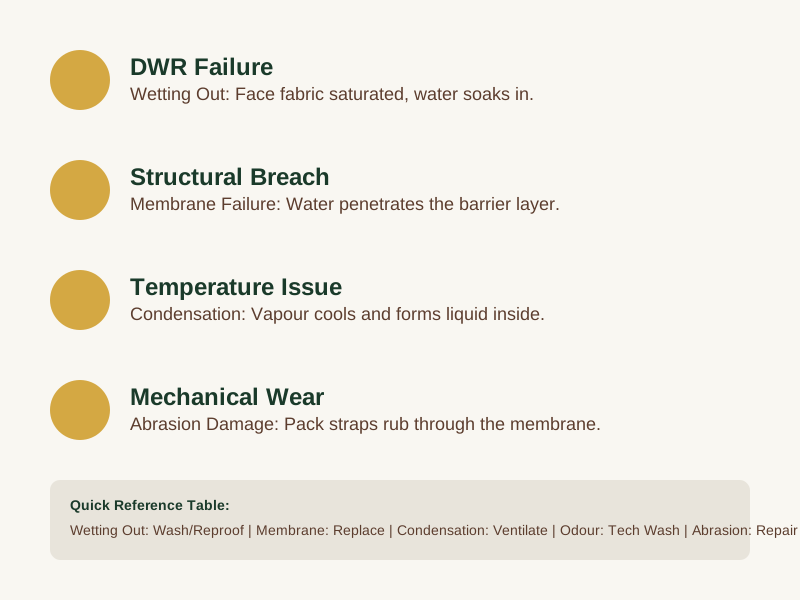
Waterproof Jacket Failure Types
| Issue | Cause | Fix |
|---|---|---|
| Wetting Out | DWR coating worn off | Wash and reproof |
| Membrane Failure | Structural breach or delamination | Repair or replace |
| Condensation | Temperature difference causing vapour to condense | Improve ventilation |
| Musty Odour | Accumulated sweat and oils | Technical wash |
| Abrasion Damage | Pack straps rubbing membrane | Repair or replace |
Frequently Asked Questions
Can I put my waterproof jacket in the tumble dryer?
Check the care label first—most Gore-Tex and similar membranes can handle a low-heat tumble dry, and the heat actually helps reactivate any remaining DWR in the face fabric. That said, always check the care label, as some garments have specific restrictions. If it can be tumble dried, a low-heat cycle is useful after washing and reproofing—not a replacement for reproofing, but a helpful boost to whatever DWR is still present.
Why does my jacket smell musty?
Musty odour is usually a sign of accumulated sweat, bacteria, and body oils that have built up in the fabric over time. A dedicated technical wash like Nikwax Tech Wash is formulated to deal with this kind of contamination in technical fabrics, and owners report it handles the smell significantly better than ordinary detergent. Heavy, longstanding mustiness may need a couple of washes to fully shift, and in a few cases professional cleaning is the only option that works.
Does washing my jacket ruin the waterproofing?
The opposite, actually. Ordinary detergent is the problem—it leaves surfactants behind that make the face fabric more wettable and block the membrane’s breathability. That’s why a technical wash exists. Washing with a proper product removes the oils and grime that are actively reducing your jacket’s performance. The waterproof membrane sits underneath the face fabric and is not affected by washing; the DWR coating on the face fabric is removed by washing, which is why you reapply it afterward. The process is what restores performance, not what damages it.
My jacket only leaks at the shoulders, where my pack straps rub. What’s happening?
This is one of the most common failure patterns owners report, and it’s a structural issue, not a DWR issue. The pack straps create repeated abrasion against the face fabric and ultimately the membrane underneath. By the time you see leaking, the membrane itself has been worn through at that point. Reproofing won’t fix it—the proofer goes on the outside, and the hole is in the membrane underneath. You need to inspect the affected area, and if the membrane is clearly damaged, a repair product or replacement is the honest answer.
Taking the Next Step
The important thing to take away is that “wet” is not a diagnosis. Three completely different things can make your jacket feel damp on a rainy walk, and the fix for each one is different—ventilation, wash-and-reproof, or repair-and-replacement. Most of the time, the problem is reversible for a small outlay. The only thing that wastes money is not knowing which problem you’re actually dealing with.
Now you know what to look for—Get the Free Waterproof Care Checklist to work through the diagnosis and match it to the right products, in order, every time.
Related Guides
For a complete overview, see our Why Waterproof Jackets Wet Out (and What to Do Instead of Buying a New One) .
Sources & Further Reading
As an Amazon Associate we earn from qualifying purchases.
Note: General guidance only, verify details with a qualified professional or official source.