Waterproof Trousers Need More Reproofing Than Jackets
As an Amazon Associate we earn from qualifying purchases. This page contains affiliate links — if you buy through them, we earn a small commission at no extra cost to you.
Waterproof trousers endure constant abrasive contact across the seat and inner thigh for the entire duration of a walk, while a jacket’s highest-wear zones like cuffs and collar only experience intermittent friction. This fundamental difference in wear patterns explains why trousers lose their water repellency faster than jackets and need more frequent, targeted reproofing.
The Durable Water Repellency coating — the DWR — is a thin hydrophobic layer bonded to the outer face fabric. It sits on top of the membrane, not underneath it, which is why a garment can feel like it is leaking when the problem is simply a worn or dirty DWR coating. The same logic applies to trousers, but the way the DWR degrades is different.
Dirt blocks the coating. Ordinary household detergent leaves residues that fill the microscopic pores in the membrane, stopping moisture vapour escaping and causing the face fabric to wet out from the inside. This is the primary mechanism of failure for any waterproof garment, and it is well documented in manufacturer care guidance — Nikwax’s own garment care pages explicitly state that detergent residue is the main culprit behind a loss of water repellency.
But with trousers there is a second mechanism that accelerates things: mechanical abrasion. Your backpack hip belt grinds against the waistband with every step. Walking poles transfer vibration and direct scraping to the inner thigh area. Sitting on wet ground compresses the fabric fibres and pushes moisture into the DWR layer, degrading its bond with the face fabric. The result is that the seat, inner legs, and waist can lose their DWR in a single season while the outer thighs and knees — which take comparatively little direct friction — are still beading water. This is a pattern that comes up repeatedly in outdoor forums, and it is one that a standard wash-in reproofing cycle will not address efficiently.
So when the seat wets out, the honest question is not “do my trousers need replacing?” — it is “which specific zones have failed, and do I need to treat the whole garment or just the high-wear areas?”
The Wear Pattern Problem
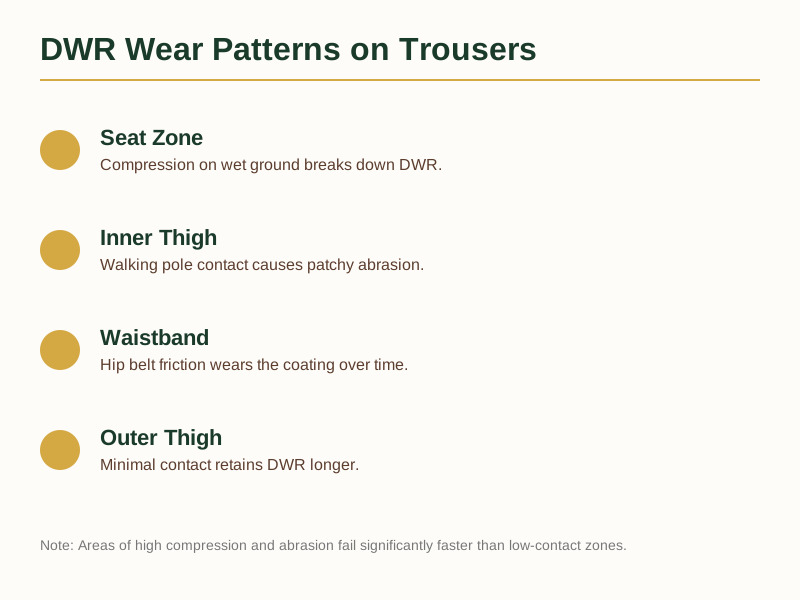
Trousers experience concentrated wear in three zones that most care advice ignores because it was written for jackets. These are the areas to inspect first when you notice wetting out.
The hip belt zone — the waistband and upper rear of the trousers. Constant friction from the pack compresses the face fabric and grinds away the DWR coating over a season.
The inner thigh and upper leg — contact with walking poles, particularly during steep descents or when using them for river crossings, scrapes a specific worn patch on each leg.
The seat — the widest surface area of contact with a wet chair, rock, or ground. Compression forces moisture into the fabric and breaks down the DWR bond faster than simple abrasion alone.
Compare this to a jacket, where the highest-wear zones are the shoulders (pack straps) and hood face — areas with broader, lighter friction across larger surface areas. Jackets do not get sat on. They do not grind against a hip belt for six hours. This is why the same wash-in treatment that works for a jacket is often the wrong tool for trousers: it applies reproofer uniformly across the whole garment when only three specific zones need it. You end up re-treating fabric that is still fine while the seat stays soaked.
A targeted spray-on reproofer applied to the high-wear zones after cleaning does a better job precisely because it concentrates product where the problem is worst. You are not re-proofing the trousers — you are re-proofing the three inches of seat fabric that actually failed.
Lightweight waterproof trousers often use thinner face fabrics than jackets to reduce weight and pack size. These lighter constructions naturally have less material to hold a DWR coating, which is why the same abrasion that would take two seasons to degrade a jacket face fabric can take one season on a pair of lightweight trousers.
Wash-In vs. Spray-On: Which Wins for Trousers?
This is the decision point, and the answer depends on what you are actually trying to achieve.
A wash-in cleaner — Nikwax Tech Wash (paid link) or Granger’s Performance Wash (paid link) — is the right first step for any waterproof garment. It removes the dirt and detergent residue that clogs membrane pores and stops the fabric breathing. Owner feedback consistently supports this: people who pair a tech wash with a separate reproofer report better results than those who use a single product over a dirty shell. Granger’s Performance Wash is a solid alternative if you prefer it, and many owners on UK outdoor forums switch between the two depending on what is available locally.
Check Granger’s Performance Wash price → (paid link)
View Nikwax Tech Wash on Amazon → (paid link)
The wash-in reproofer — applied to the drum or the fabric itself during the wash cycle — does exactly what it says on the tin for a jacket. It coats the entire garment uniformly, which is appropriate when general face-fabric wear is the main concern. For trousers, it is inefficient: you are treating the knees and shins that are still working fine.
A spray-on reproofer — Nikwax TX.Direct Spray-On (paid link) applies the DWR coating only where you direct it. Owner reports describe it as getting a solid, functional DWR back on treated areas, though they also note it needs reapplying more frequently than a factory finish. The spray-on route also lets you treat a damp garment directly, which the wash-in cycle does not.
Check Nikwax TX.Direct Spray-On price → (paid link)
The two-in-one products — Granger’s Wash + Repel Clothing 2 in 1 (paid link) (300 ml) is the best-known — combine cleaning and reproofing in a single machine cycle. They are genuinely convenient and they work well for routine maintenance. The honest trade-off is that they treat the whole garment equally, which means they are best suited for general maintenance rather than targeted repairs on a pair of trousers with localised wear.
Buy Granger’s Wash + Repel Clothing 2 in 1 on Amazon → (paid link)
The stakes-weighted call is this: for a pair of waterproof trousers with a wet seat and intact legs, a spray-on applied to the failed zones after a tech wash is the right tool. The cost of failure — a soaked seat on a long wet walk — is immediate and uncomfortable, and it is concentrated in a small area that the spray can fix directly. Wash-in reproofing is still worth doing for cleaning, but do not expect it to resolve localised seat and waist failure on its own.
Flip to a wash-in reproofer if your trousers have lost DWR uniformly across the whole garment — typically after several seasons of heavy use — because in that case the whole surface is failing and targeted treatment would take too long.
How to Reproof Your Waterproof Trousers
The reproofing process is straightforward enough to do on a weekday evening, with most of the time spent waiting for machines to finish.
Clean first. Put the trousers through a 30°C synthetic cycle with Nikwax Tech Wash (paid link) or Granger’s Performance Wash (paid link) — Nikwax instructions suggest 150 ml for one to three garments. Do not use ordinary laundry detergent or fabric softener; both leave residues that will clog the membrane and undo everything you are about to do. Many outdoor brands explicitly warn against standard detergent in their care guidance, including Gore-Tex and Nikwax.
Rinse thoroughly. Run a second quick rinse cycle to clear any lingering surfactant from the fabric.
Dry the trousers. Check the care label first — some garments specify no tumble drying. If a condenser tumble dry on a low heat setting is allowed, this also helps reactivate any remaining DWR in the fabric. If not, air dry flat or on a clothes line.
Apply spray-on reproofer to the high-wear zones. Hold the bottle about 15 cm from the fabric and apply an even coat to the seat, inner thighs, and waistband — the zones identified above. Do this while the fabric is still damp from cleaning. Owners of TX.Direct Spray-On note that it works best when applied to a clean, damp garment; applying it to dry fabric or over detergent residue gives patchy results.
Heat activate if allowed. If the care label permits, a short tumble dry on low heat will help bond the new DWR coating to the face fabric. This step is optional but it does improve the beading on most formulations.
The hands-on part is spraying the three high-wear zones, which takes under five minutes. The rest is machine time.
Now you know what to look for and how to fix it — grab the Free Waterproof Care Checklist to keep track of when to clean and reproof your kit through the season.
Frequently Asked Questions
Can I put waterproof trousers in the tumble dryer?
Check the care label on your specific pair. Gore-Tex’s current outerwear guidance allows warm gentle tumble drying, but some manufacturers — particularly on lighter constructions — may advise against tumble drying. If the label permits it, a low-heat condenser cycle will help heat-activate the new DWR coating. If it does not, air dry flat.
Why are my knees wet but my thighs are dry?
This is a textbook localised wear pattern. Walking pole friction wears the DWR on the knees while the thighs above stay protected under gaiters or underlayers. It is not a membrane failure — it is a specific abrasion zone that needs a targeted spray-on treatment on the knees, not a full wash-in reproof. The same pattern appears at the waist and seat.
Do I need to reproof my trousers every time I wash them?
No. Washing cleans the fabric; reproofing restores the DWR coating. You only need to reproof when the face fabric stops beading water. For a pair of trousers worn most weekends, you’ll likely need to reproof more frequently than the care label suggests — typically whenever the high-wear zones start wetting out rather than beading.
High-Wear Zones for Waterproof Trousers
| Zone | Primary Cause of Wear | Typical Failure Pattern |
|---|---|---|
| Seat | Compression on wet ground | Localised wetting out, fabric breakdown |
| Inner Thigh | Walking pole contact | Patchy abrasion, reduced beading |
| Waistband | Hip belt friction | DWR coating wear, seam stress |
| Outer Thigh | Minimal direct contact | Generally retains DWR longer |
| Knee | Walking pole vibration | Specific abrasion zone, often dry while thighs are wet |
Reproofing Frequency for Weekly Use
Based on the wear-pattern data, waterproof trousers used for weekly UK hill walks will typically need reproofing every 4-6 weeks during peak season — more frequently than most care-label guidance recommends. Use the Free Waterproof Care Checklist as your interval-tracking reference to maintain performance between major cleanings.
General guidance only, verify details with a qualified professional or official source.
Explore More Topics
Go deeper on specific topics:
- Kids’ Waterproofs: Same Rules, Faster Wear
- Gloves and Overmitts: Small-Item Proofing Guide
- How to Store Waterproofs So They Don’t Die in the Cupboard
- Leather Walking Boots: Clean, Wax, or Proof?
As an Amazon Associate we earn from qualifying purchases.