Why Waterproof Jackets Wet Out (and What to Do Instead of Buying a New One)
As an Amazon Associate we earn from qualifying purchases. Some links on this page are affiliate links, which means we may earn a small commission if you make a purchase.
Most people misread wet-out. When the outer fabric darkens and feels heavy, they assume the jacket is leaking. The membrane has failed. Time for a replacement. The reality is different: the face fabric can be completely saturated while the waterproof membrane underneath is still doing exactly what it was built to do. The water isn’t coming through; it’s just sitting on the outside, blocking breathability and making the jacket feel like it’s failed.
The fix is not a new jacket. It’s a clean and a reproof.
This article explains why jackets wet out, how to tell the difference between a dirty DWR and a dead membrane, and what to do about it. The fix is simpler than most people think.
The Wetting-Out Test: Is It Dirt or Is It Dead?
Before you decide anything, you need to know what you’re actually dealing with. There are two quick tests you can do at home that will tell you most of what you need to know.
The spray test is the one outdoor-care specialists and brands like Mountain Equipment describe in their care guidance. Lay the jacket flat on a towel, let it dry fully at room temperature, then spray a small section of the outer fabric with water from a short distance. Watch what happens: if the water beads up and rolls off, the DWR is still working — water is reaching the membrane but not soaking through the face. If the water soaks in and the fabric goes dark immediately, the DWR is gone.
The second test is to feel the jacket from the inside while it’s wet. If it’s damp against your base layer but you’re not standing in a downpour, what you’re feeling is usually condensation — the jacket’s outer face is soaked through so the moisture you produce can’t escape, so it condenses on the inside of the shell. That’s a DWR problem, not a leak. The membrane is doing its job; the breathability has just been choked off by a saturated face fabric.
Wetting out occurs when the durable water repellent (DWR) coating on your outdoor gear wears off and the fabric starts to absorb water instead of repelling it. This is the mechanism that matters. It’s a reversible process, and understanding it is what separates a cheap fix from an expensive mistake.
The Real Culprit: DWR vs. Membrane
A waterproof jacket has two separate layers doing two separate jobs. Understanding what each one does is the key to understanding why your jacket has stopped working.
The membrane is the waterproof barrier. In most modern jackets it’s either ePTFE (expanded PTFE — the material Gore-Tex is based on) or a polyurethane (PU) layer. This is what stops liquid water from passing through. It does not wear out from use. It is not the thing that fails when your jacket starts soaking through on a rainy walk. It fails from physical damage — a tear, a burn, or delamination where the membrane separates from the face fabric, usually from age, solvent exposure, or an aggressive wash.
The DWR coating sits on top of the membrane, bonded to the outer face fabric. It’s a sacrificial hydrocarbon layer — it beads water, keeps the face fabric dry, and protects the membrane from oils, sweat, and grime that would otherwise clog the microscopic pores that make the jacket breathable. This coating wears off over time. It gets abraded by rucksack straps, washed away by the wrong detergent, and gradually absorbed by body oils and the grimy reality of outdoor use. That’s what wetting-out is: the DWR has gone, the face fabric is now wettable, and water soaks through to the membrane. The membrane is still waterproof; the jacket just looks and feels like it’s leaking.
This is the distinction that matters most. Nikwax’s own guidance on cleaning and re-waterproofing describes the process as removing the contamination that’s covering the DWR coating, then replenishing that coating — not replacing the membrane. Mountain Equipment’s care documentation is explicit: DWR isn’t what makes a jacket waterproof, but it helps the garment breathe and dry more effectively.
When DWR wears off, two things happen. First, the face fabric soaks up water, making the jacket heavy and cold — water conducts heat away from the body far faster than air does, which is why a wet-out jacket feels much colder than it actually is. Second, the clogged face fabric loses breathability, so the moisture you produce has nowhere to go, and you get the damp feeling from the inside as well. Both problems are caused by a dirty or depleted DWR. Neither requires a new jacket to fix.
The Fix: Wash, Don’t Replace
Here is the decision in its simplest form. Is the jacket physically damaged? Torn fabric, seam tape coming loose, or visible delamination where the face fabric bubbles away from the membrane — those are replacement territory. If none of those apply, the fix is a two-step process: clean first, then reproof.
The spray test tells you whether the DWR is simply dirty or genuinely depleted. If a clean jacket still doesn’t bead after a wash, the DWR has worn off and needs replacing. If it does bead after washing, you’ve solved the problem — the jacket just needed the grime removed.
The wash step is non-negotiable. You cannot reproof a dirty jacket and expect it to work. Body oils, sweat residue, and outdoor grime sit on the face fabric and block a new DWR from bonding properly. Spray-on reproof over a dirty shell is the most common way people waste a bottle and then conclude that reproofing doesn’t work. It does; it just can’t work over a layer of grease and dirt. The Nikwax guidance on cleaning and re-waterproofing is direct: most times it’s dirt and crud covering the water-repellent coating that makes your jacket soak up water. Remove the dirt first.
For most UK machines, a 30°C wash on a gentle cycle with a specialist technical cleaner — Nikwax Tech Wash (paid link) or Granger’s Performance Wash (paid link) (1 L) — is a common route. Both are purpose-built for breathable fabrics and neither contains the surfactants that household detergents leave behind. Ordinary laundry detergent is formulated to leave fabrics feeling soft and smelling fresh — that is the opposite of what a hydrophobic coating needs. Those residues are wettable, which means they actively attract water and undermine the beading you’re trying to restore.
View Granger’s Performance Wash on Amazon → (paid link)
View Nikwax Tech Wash on Amazon → (paid link)
After the wash, apply a DWR treatment. For a jacket where the face fabric is still structurally sound, Nikwax TX.Direct (paid link) (wash-in) is a widely used option for restoring water repellency. Granger’s Clothing Repel (paid link) is a comparable alternative. The honest budget pick — Granger’s Performance Wash (paid link) — cleans well but may not fully restore DWR on heavily worn gear, where a dedicated reproof treatment is worth the extra step.
Check Nikwax TX.Direct price → (paid link)
What about heat? Low tumble-dry heat (on a setting the care label permits) can help redistribute any remaining DWR so beading returns faster. It won’t invent a coating that has genuinely worn off, but on a jacket with some DWR left, it’s a useful nudge. If the care label allows tumble drying and the machine has a low-heat setting, this works in a UK home.
If the care label says no tumble drying, hang the jacket somewhere warm and dry — an airing cupboard works well. The key is letting heat activate the new coating evenly across the fabric.
The two situations where washing and reproofing will not help: a physical tear or delamination where the membrane has separated from the face fabric. These are visible — you’ll see bubbling, peeling, or the face fabric will feel loose and papery. Those are the cases where replacement is the answer. For everything else, the jacket is fixable.
Now you know what to look for — Get the Free Waterproof Care Checklist for a step-by-step guide to washing and reproofing your jacket at home.
Product Guide: What to Use
Not all cleaning and reproofing products are equal, and the right choice depends on what you’re starting with.
Nikwax Tech Wash (paid link) is an established specialist cleaner for waterproof breathable kit. It’s what brands like Outdoor Research recommend specifically for maintaining water repellency, and it’s what the care guidance from manufacturers points toward. It’s straightforward to use in a standard machine, and it does a solid job of removing the oils and grime that block breathability and kill DWR. The limitation is that it is a cleaner only — it does not apply a new DWR. That step is separate. Some buyers say it won’t shift stubborn stains or musty odours from heavily used kit, but that’s not what it’s designed for. For regular maintenance, it’s the right tool.
Granger’s Performance Wash (paid link) (1 L) is the accessible alternative that comes up in forum recommendations. It’s effective at cleaning technical fabrics, it rinses well, and owners describe it as a reliable option that is easy to find in UK outdoor shops. The caveat worth knowing is that it may not fully restore DWR on heavily worn gear — the stuff that has been through hundreds of washes and is starting to feel like a sponge. For a jacket in reasonable condition, it is the honest budget pick. For a jacket that has genuinely given up, you will still need a dedicated reproof treatment on top.
Nikwax TX.Direct (paid link) is the reproof half of the equation. It adds a new DWR coating to the face fabric, and when used after a proper tech wash on a jacket that is otherwise sound, it extends the life of the jacket significantly. Owners describe it as straightforward to apply and effective at restoring water beading. The common complaint is the smell. The other thing to watch: results on older gear can be mixed. A jacket that has had years of detergent washing and heavy use may need additional treatment before beading returns fully. That is not the product failing — it’s the condition of the jacket.
Granger’s Clothing Repel (paid link) does a similar job and is often described as the best option for routine DWR maintenance by owners who use it regularly. The results are not always brand-new factory level, and it works better on a clean jacket than on one with heavy soiling — which is consistent with how all DWR chemistry works. If you’ve cleaned the jacket properly first, it restores beading effectively.
Check Granger’s Clothing Repel price → (paid link)
The one thing worth flagging: wash-in reproofers versus spray-on applications are debated in forums. Wash-in versions generally give more even coverage across the whole garment, while spray-on versions like Nikwax TX.Direct Spray-On (paid link) are useful for spot-treating a worn hood or shoulders without reproofing the whole jacket. For a full jacket refresh, wash-in is the more reliable route.
Check Nikwax TX.Direct Spray-On price → (paid link)
Frequently Asked Questions
Can I use normal laundry detergent on my waterproof jacket?
No. Standard household detergent is formulated to leave surfactants and softeners behind — those residues are wettable, which actively works against the DWR coating you’re trying to maintain. Using it is the single most common way people accidentally degrade their jacket’s water resistance between wears. Stick to a specialist technical wash.
How often should I wash my waterproof jacket?
Regular washing is essential for maintaining the best possible performance over many years. Nikwax’s own care guidance makes this point explicitly: a clean jacket performs better than a dirty one. More often if you’ve been through heavy mud or used it in very sweaty conditions.
Will washing my jacket ruin it?
No, if you follow the care label and use the right product. A 30°C gentle cycle with a specialist technical cleaner is the standard route. The things that damage a membrane are harsh detergent, high temperatures, and fabric softener. Use the right wash and the machine is not the enemy.
Can I put my waterproof jacket in the tumble dryer?
Yes, if the care label permits it. Low heat from a tumble dryer can help reactivate any remaining DWR after washing, which is why many manufacturers recommend it. In a UK home — or in winter when line drying takes days — a tumble dryer is genuinely useful for this. Just check the label first and don’t use high heat.
Waterproof Jacket Care Products
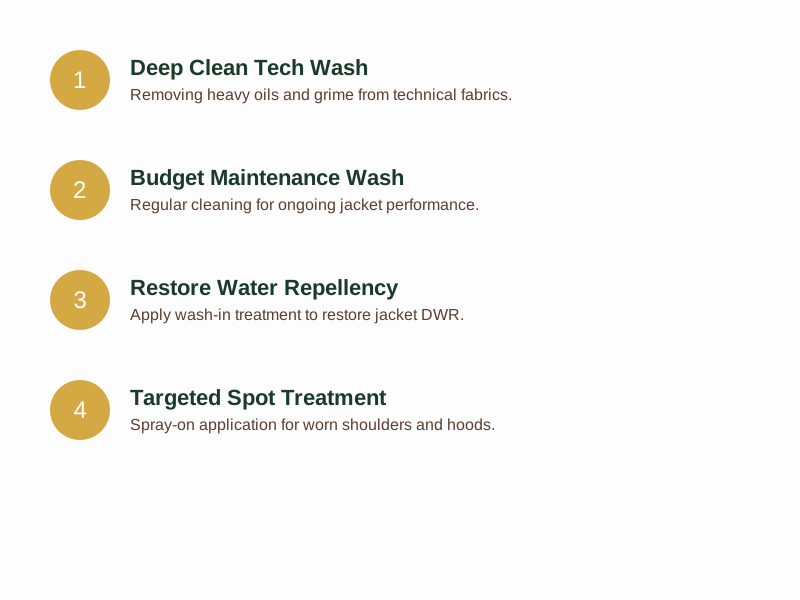
The key products for cleaning and reproofing include Nikwax Tech Wash for removing oils and grime, Grangers Performance Wash for budget-friendly regular cleaning, Nikwax TX.Direct for restoring water repellency on clean jackets, Grangers Clothing Repel for routine DWR maintenance, and Nikwax TX.Direct Spray-On for spot-treating worn areas like the hood or shoulders.
Where to Go From Here
The honest answer for most people with a wetting-out jacket is this: your jacket is probably fine. The membrane is doing its job. The DWR coating has worn off or is clogged with grime, and that is what a specialist wash and a reproof treatment fixes.
The observable sign that the membrane itself has failed is visible damage: bubbling where the face fabric separates from the membrane, peeling seam tape, or tears you can see light through. If you can’t find any of these, you almost certainly have a DWR problem, not a membrane problem.
If you are ready to tackle it, the next step is straightforward: get the jacket clean first, then reproof it. Everything else follows from that.
Get the Free Waterproof Care Checklist for a clear, step-by-step guide to washing and reproofing at home — the right products, the right order, and what to check before you start.
Explore More Topics
Go deeper on specific topics:
- Wetting Out vs a Failed Membrane vs Condensation: How to Tell the Difference
- Waterproof Jacket Still Leaking After Reproofing: What You Missed
- Seam Tape Failure vs DWR Failure: Which Is Causing Your Leak
- When to Reproof vs When to Replace a Waterproof Jacket
- When a Waterproof Jacket Was Never Waterproof: Coating vs Membrane
Sources & Further Reading
As an Amazon Associate we earn from qualifying purchases.
Note: General guidance only, verify details with a qualified professional or official source.