Wash-in vs Spray-on Reproofer: Which Wins?
As an Amazon Associate we earn from qualifying purchases. This page contains affiliate links — if you buy through them, we earn a small commission at no extra cost to you.
A wash-in reproofer reaches every internal seam and baffle as the garment tumbles through the machine; a spray-on reproofer cannot penetrate these hidden areas. This coverage difference in application physics dictates which method works best for your jacket’s condition.
Both methods work by bonding to remaining factory DWR coating—they replenish rather than replace. If the original coating is substantially gone, neither will restore factory-level performance. The choice depends on how much of your jacket needs treating and whether enough original DWR remains to make reproofing worthwhile.
Our Pick
- Jacket's lost beading all over? Nikwax TX.Direct (wash-in) reaches every seam and baffle in one machine cycle. Check Amazon price →
- Only the shoulders and hood have gone, or you've got leather trim/mesh panels? Nikwax TX.Direct Spray-On targets just the worn area. Check Amazon price →
Understanding the Reproofing Mechanism
Reproofers like Nikwax TX.Direct (paid link) and Granger’s Performance Repel Plus bond to existing Durable Water Repellent coating on your jacket’s face fabric. They don’t create a fresh coating from scratch.
This distinction is crucial. When years of use and washing have worn away the original factory DWR, there’s little for the reproofer to adhere to. The result is weak, uneven coating that degrades quickly. Mountain Equipment’s care guidance emphasises cleaning before reproofing to provide the best foundation, but only if sufficient original coating remains. It’s essential to avoid using ordinary detergent, which leaves wettable residues that prevent proper DWR bonding. Always use a specialist cleaner like Nikwax Tech Wash (paid link) or Granger’s Performance Wash (paid link) first to remove these residues.
Check Granger’s Performance Wash price → (paid link)
Wash-in Reproofing: Complete Coverage
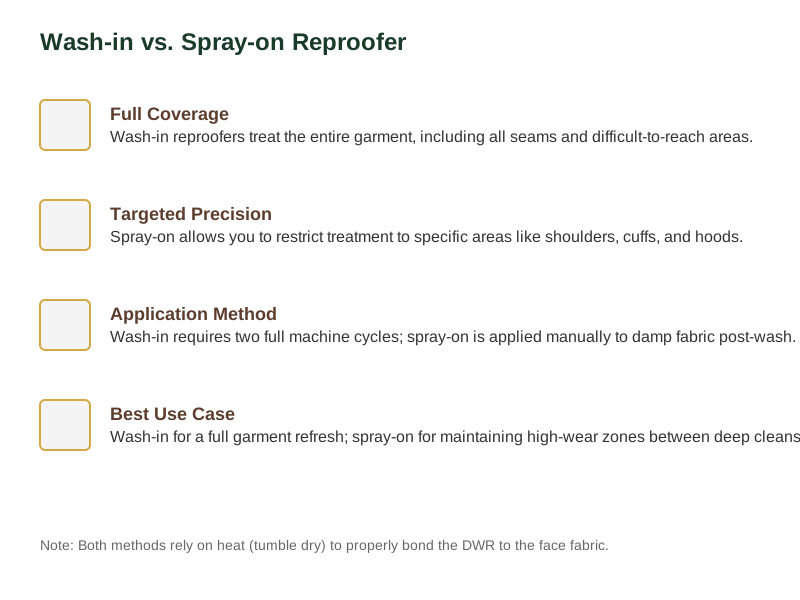
Machine washing disperses reproofer throughout the entire garment, treating outer fabric, stitching, and hard-to-reach seam areas that spray application often misses. The mechanical agitation ensures proofer reaches under storm flaps and inside baffles.
This method offers consistent coverage across the whole garment surface. For jackets that have lost beading everywhere, this matters—missed patches will wet out first. The trade-off is that wash-in reproofers also treat the lining, which some wearers notice as a texture change.
The correct process involves using a specialist cleaner like Nikwax Tech Wash (paid link) first, followed by the reproofer in a separate cycle. A gentle tumble dry afterwards can help reactivate the coating if the care label permits, though it’s not always strictly necessary. Following the care label — a warm, gentle cycle for a short spell if it’s permitted — can be beneficial.
Check Nikwax Tech Wash price → (paid link)
View Nikwax TX.Direct Wash-In on Amazon → (paid link)
Spray-on Reproofing: Localised Treatment
Spray-on reproofers allow targeted application to specific high-wear zones like hoods and shoulders without treating areas that still perform well. For jackets with localised DWR loss, this avoids product waste.
Nikwax TX.Direct Spray-On (paid link) is praised for ease of use and effective results on clean gear. Application to a damp jacket helps the formula spread evenly across the fabric.
The limitation is coverage consistency—complex seams and stitch lines may receive uneven coating depending on application thoroughness. Spray-on is ideal for jackets that bead well overall but need spot treatment in friction areas. It is also genuinely superior for multi-material jackets with leather trim or mesh panels that can’t withstand full machine washing, as it allows targeted treatment of the waterproof sections without damaging delicate materials.
Choosing Between Methods
The decision hinges on coverage needs versus precision. Wash-in provides uniform treatment across the entire garment, making it suitable for jackets that have lost beading everywhere. The machine ensures even distribution to all seams and internal areas.
Spray-on wins for efficiency when only specific areas need treatment. It concentrates product where it’s needed most and leaves the lining unaffected. However, results depend entirely on application thoroughness.
For jackets with substantially degraded original DWR across the entire surface, wash-in reproofing offers the best chance of even bonding. For localised wear on hoods or shoulders, spray-on is more efficient. When the original factory coating is fully gone, neither method will deliver lasting results—replacement becomes the practical option. If a jacket still leaks after reproofing, it usually indicates either substantially depleted original DWR (leaving little for reproofer to bond with) or actual membrane failure. If the jacket wets out from the inside, inspect for seam tape delamination or membrane damage—issues reproofing cannot fix.
Product Performance Insights
Nikwax TX.Direct (wash-in) effectively restores water beading according to product testing, though it requires reapplication after regular use. On jackets where the original DWR is substantially depleted, results may disappoint due to the bonding mechanism.
Nikwax TX.Direct (spray-on) provides reliable spot treatment for localised DWR loss. The spray format allows precise application but coverage depends on user thoroughness.
Granger’s Performance Repel Plus works well on clean gear with remaining DWR, though durability doesn’t match factory treatments. Effectiveness varies when original coating is heavily worn.
Key Differences at a Glance
| Feature | Wash-in | Spray-on |
|---|---|---|
| Coverage | Entire garment including seams | Targeted areas only |
| Application | Machine wash cycles | Manual spray application |
| Best Use Case | All-over DWR loss | Localised wear zones |
| Lining Treatment | Included | Unaffected |
| Consistency | Machine-controlled | User-dependent |
When Spray-on Actually Wins
For multi-material jackets with leather trim or mesh panels that can’t withstand full machine washing, spray-on reproofing is genuinely superior. It allows targeted treatment of the waterproof sections without damaging delicate materials that would be compromised by wash-in processing.
Use the checklist below to select the right format for your specific jacket construction, followed by any required care instructions.
- Free Waterproof Care Checklist - Format selection reference
- Nikwax vs Granger’s: Product Matching Guide
Get the Free Waterproof Care Checklist to diagnose whether reproofing is appropriate or if replacement is needed.
Reference Sources
As an Amazon Associate we earn from qualifying purchases. The products linked above are ones we recommend based on independent research.
Note: General guidance only. Verify specific care instructions with the garment manufacturer.