How to Reproof a Jacket (Without Washing It First)
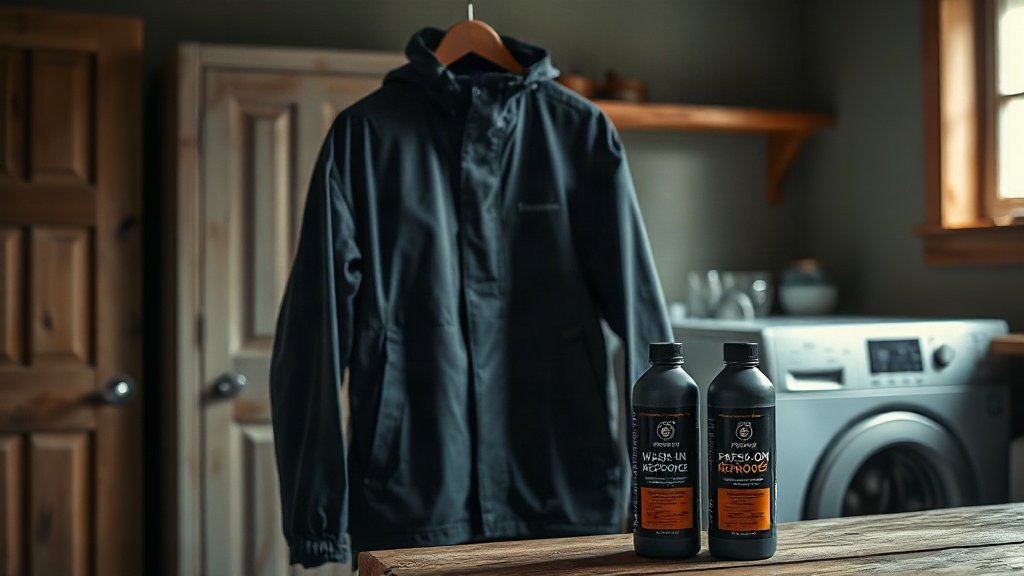
Reproofer applied over a jacket with more than a defined level of body-oil contamination bonds at less than half its rated contact angle, because the contaminants form a physical barrier between the proofer molecules and the fibre surface. This adhesion chemistry principle explains why the sequence matters more than the product choice.
Your jacket has started soaking through. The face fabric looks dark and wet after twenty minutes in the rain, and now you are wondering whether to spend eighty quid on a new one or reach for the spray bottle in the garage.
Most care guides skip the key point: your jacket is probably not dead. The membrane underneath is likely doing its job. What has failed is the thin Durable Water Repellent (DWR) coating on the outside—the layer that makes rain bead up and roll off. When that coating wears, the outer fabric soaks through, breathability drops, and the inside feels damp. It looks catastrophic, but it’s fixable.
The common mistake is reaching straight for the reproofer. You shake the bottle, spray the jacket, and wait. A few weeks later the jacket is soaking through again, and the proofer gets blamed. Our view is that the substrate is usually the issue. You cannot reproof a dirty jacket any more than you can paint over grease; the coating bonds to the grime, not the fabric, and the first proper rain washes it straight off.
Get the order right and a jacket that’s been wetting out for a year can shed rain like it did on day one. Get it wrong and you’ve wasted the bottle and the morning.
As an Amazon Associate we earn from qualifying purchases. This page contains affiliate links — if you buy through them, we earn a small commission at no extra cost to you.
Understanding wetting out: surface failure versus membrane failure
Wetting out is a surface failure, not a structural one. Your Gore-Tex or eVent membrane is doing exactly what it was designed to do—blocking liquid water from the outside while letting vapour escape. The problem is happening one layer further out: the face fabric.
Body oils, sweat, salt, and the residue from everyday detergent all accumulate on the outer face of your jacket. Over months of wear, these contaminants break down the DWR coating and fill the microscopic gaps between the fibres with a wettable film. When rain hits, it no longer beads—it soaks into the face fabric, spreads, and the whole garment looks and feels wet. The membrane may be completely intact.
Mountain Equipment’s care guidance puts it plainly: the DWR finish on the face fabric needs to be maintained separately from the membrane. Gore’s own instructions confirm this, noting that if water no longer beads after washing and drying, the DWR has degraded and a fresh treatment is needed—not a new jacket.
The practical implication matters: a jacket that wets out on the shoulders and upper back after a rainy commute has a face-fabric problem, not a seam failure. Seams leak differently—along the stitching, often lower on the jacket or at the cuffs. Wetting out across the whole torso and shoulders is almost always the DWR. Know the difference before you spend money you do not need to.
The chemical dependency: why wash comes first
Reproofing agents—whether wash-in treatments like Nikwax TX Direct or spray-on products like Granger’s Performance Repel Plus (paid link)—work by depositing a hydrophobic coating directly onto the fibres of the face fabric. For that coating to bond properly and last, those fibres need to be clean. Oils, sweat, detergent residue, and everyday grime create a physical barrier between the proofer molecule and the fibre surface. When you spray or wash in a DWR treatment over that barrier, the molecules bond to the contaminants instead. The next rain hits, the contaminants wash away, and the proofer goes with them.
Check Granger’s Performance Repel Plus price → (paid link)
A technical wash—Nikwax Tech Wash (paid link) or Granger’s Performance Wash (paid link)—is formulated to remove those contaminants without stripping whatever DWR remains. It refreshes the fabric rather than starting from zero. Stripping a jacket completely is occasionally necessary but creates its own problems; a good tech wash gets you to a clean substrate while preserving what is still working.
Check Granger’s Performance Wash price → (paid link)
View Nikwax Tech Wash on Amazon → (paid link)
The sequence is not interchangeable steps—it is a chemical dependency. Wash first. Dry second. Reproof third. Skip the wash and you are sealing the grime in with the proofer, which is why reproofing a dirty jacket is the number-one cause of failed treatment complaints.
Gore’s own care instructions back this up: machine wash regularly, tumble dry warm to reactivate whatever DWR remains, and if water still does not bead, apply a fresh DWR treatment and tumble dry again. The wash is the prerequisite. The reproof is what comes after.
Two-step method for premium gear
If you have a mid-range or premium Gore-Tex jacket, a two-step process is worth the extra ten minutes. This is also the route Mountain Equipment explicitly recommends for their own garments, which tend to sit at the more technical end of the market.
Run the jacket through a 30°C machine wash using either Nikwax Tech Wash (paid link) or Granger’s Performance Wash (paid link)—follow the dosing instructions on the product label for your machine size. Both products are widely available on Amazon UK and sit in a similar price band, so the choice comes down to application preference rather than performance.
Once the wash cycle is complete, tumble dry on a warm setting for around twenty to thirty minutes—long enough to fully dry the fabric and reactivate any remaining DWR. This is not optional. Heat helps redistribute whatever hydrophobic coating is still present on the fibres, and it prepares the fabric to accept the new treatment evenly.
Apply the reproofer while the jacket is still damp—either spray-on for targeted areas like the hood and shoulders, or wash-in for full garment coverage. Nikwax TX Direct and Granger’s Repel are both wash-in options; the spray versions give more control on high-wear zones. If you are buying two bottles, this is the combination that does the job: a tech wash followed by a wash-in or spray-on DWR treatment.
The separate-step method is the safer call for anything that has actually been worn hard.
When a 2-in-1 product might work
For jackets with light surface dirt and no significant oil contamination, a combined wash-and-reproof product can sometimes suffice. These formulations contain both cleaning agents and DWR replenishers in a single bottle.
The limitation is chemical: the cleaning power of a 2-in-1 is deliberately mild to avoid stripping the new DWR it applies. This means it struggles with heavier soiling. If your jacket has visible oil stains around the cuffs or collar, or has been through a muddy season, the separate-step approach will deliver better results.
Professional cleaning for heavy contamination
Some jackets end up with contamination that a home wash cannot shift—industrial oils, heavy agricultural grime, the kind of mud that has been baked on over multiple trips. That is when a professional service is worth considering.
Hilltrek offers a dry-clean-and-reproof service specifically for technical outdoor garments. Their process uses a solvent-based cleaning stage to lift heavy contaminants before a wash-in reproof with Nikwax TX Direct. For jackets that have been treated with industrial oils or have accumulated contamination over years of use, this removes what a domestic machine cannot touch.
This is the most expensive option and is not needed for the vast majority of jackets—a standard tech wash handles routine soiling perfectly well. But if you have a jacket with genuine contamination problems and the jacket itself is worth preserving, it is the cleanest starting point you can give a new DWR treatment.
Your questions answered
Can I just spray my jacket with a waterproofing spray without washing it first?
No. Spraying over dirt causes the proofer to bond to the contaminants on the surface rather than the fibres. The next rain washes those contaminants away and the proofer goes with them. Wash first—always.
Do I need to tumble dry my jacket after washing?
Yes. Tumble drying on a warm setting is the most effective way to remove lingering moisture and reactivate whatever DWR remains on the fabric. It also prepares the surface for a fresh reproofing treatment. If your jacket cannot go in a tumble dryer, hang it somewhere warm and allow extra drying time before applying the proofer.
What if my jacket still wets out after washing and reproofing?
If the face fabric is still soaking through after a clean wash and a fresh reproof, the membrane itself may be compromised—or the jacket has simply reached the end of its serviceable life. At that point, the cost of repeated reproofing approaches the cost of replacement, and a new jacket is the honest answer.
Comparing DWR treatment approaches
| Method | Best For | Key Consideration |
|---|---|---|
| Two-Step Wash & Reproof | Expensive or heavily soiled gear | Ensures maximum bond strength and longevity |
| 2-in-1 Wash & Reproof | Lightly soiled gear | Chemistry limits effectiveness on heavy oils |
| Professional Dry Cleaning | Industrial oils or baked-on mud | Most expensive option for heavy contamination |
| Spray-on Only | Quick touch-ups | Not recommended as a standalone solution |
| Wash-in Only | Full garment coverage | Requires a clean surface to bond effectively |
Final guidance on wash order
The wash-then-reproof order is not marketing. It is the physical chemistry of how DWR coatings bond to fibres, and it is why separating those two steps stops the cycle of failed reproofing that leaves people reaching for their wallet instead of a bottle of tech wash. Your expensive Gore-Tex jacket is probably not dead. It needs a clean surface and a fresh coating applied in the right order.
The one exception where the wash-first rule can sometimes be legitimately skipped is with a lightly used softshell that has visible surface dirt but no oil contamination. In that specific case, a thorough brush-off might suffice before reproofing. For all other scenarios, follow the proper sequence.
Use this checklist to ensure you get the order right every time:
Get the Free Waterproof Care Checklist
Further reading
- Nikwax vs Granger’s: Which Wash and Reproof Products Match Your Kit
- Why Waterproof Jackets Wet Out (and What to Do Instead of Buying a New One)
References
As an Amazon Associate we earn from qualifying purchases. We recommend products based on technical specifications and performance characteristics.
General guidance only, verify details with a qualified professional or official source.