Can a UK 30°C Cycle Ruin a Membrane Jacket?
As an Amazon Associate we earn from qualifying purchases. Some links on this page are affiliate links, which means we may earn a small commission if you make a purchase.
The temperature of a wash gets all the attention, but for a membrane jacket, it’s rarely the deciding factor. Spin aggression and detergent choice are the wash factors that most often stress the jacket’s construction over time. A 30°C cycle is perfectly safe for modern waterproof membranes; the risk lies elsewhere.
The honest answer is that a 30°C wash cycle will not ruin a membrane jacket. What trips people up is the spin cycle—specifically, whether your jacket is old enough that the adhesive bonding the membrane to the face fabric has quietly degraded over years of use. Understanding that distinction is what separates a jacket that lasts another five years from one that ends up in the bin after a routine wash.
A 30°C wash is well within the safe operating window for modern waterproof membranes. The membrane itself isn’t going to melt or delaminate from heat alone. Where things get more complicated is the spin cycle. Washing machines often run synthetic programmes at higher spin speeds unless you manually intervene. That matters more than the temperature.
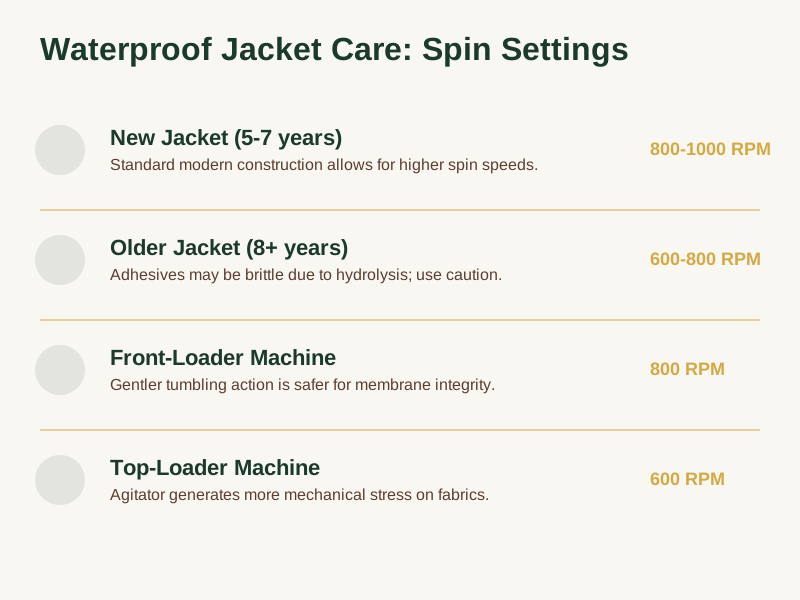
The mechanism is straightforward. Inside a waterproof shell, the membrane is bonded to the face fabric in a laminate construction. On a newer jacket, this bond is flexible and resilient. On a jacket exposed to years of moisture and repeated wash cycles, the adhesive can become brittle. Once that happens, the centrifugal force of a high-speed spin acts like a centrifuge, pulling at that weakened interface. It’s the physical stress that’s the problem, not the heat.
What this looks like in practice is delamination: the membrane separating from the face fabric, usually starting at the edges or the seams. That kind of failure almost always traces back to a combination of age and mechanical stress during the spin—not the detergent, not the temperature.
The fix is simple and costs nothing: check your machine settings before you start. Most washing machines have a manual spin speed selector. Set it to a lower speed for older jackets. That single adjustment removes the biggest mechanical risk. If your machine doesn’t let you reduce the spin speed independently of the programme, look for a dedicated delicates or handwash cycle—but still verify the rpm, because some machines default high even on gentler settings.
Machine type also plays a role. Front-loading machines are generally considered kinder to technical garments due to their tumbling action and more predictable spin dynamics. Top-loading machines with a central agitator can generate more mechanical stress on the fabric.
What really damages a waterproof jacket
Fabric softener is particularly damaging for waterproof jackets. It leaves a residue on the fibres that clogs the membrane’s pores—the tiny openings that allow sweat vapour to escape while blocking liquid water. Once that coating builds up, the jacket stops breathing. The DWR (durable water repellent) coating on the face fabric also takes a hit, because fabric softener makes the fibres hydrophilic.
Ordinary household detergents can also cause problems. They’re designed for everyday fabrics and can leave residues that sit in the weave of a technical fabric and compromise performance. Technical washes like Nikwax Tech Wash (paid link) or Granger’s Performance Wash (paid link) are formulated to clean without leaving anything behind. Many owners find that a dedicated technical wash removes built-up odours and improves water beading even before reproofing.
Check Granger’s Performance Wash price → (paid link)
Check Nikwax Tech Wash price → (paid link)
So the short version is: use a technical wash, never use fabric softener, and keep the spin speed sensible—particularly on older kit.
The correct sequence for washing and reproofing
The order matters more than most people realise. Washing and reproofing are two separate jobs that need to happen in the right sequence, and skipping the wash step before reproofing is the most common reason that reproofing fails.
The DWR treatment—whether wash-in or spray-on—has to bond directly to the face fabric fibres. If those fibres are coated in body oils, grime, and detergent residue, the reproofer bonds to the contamination instead. The jacket looks like it’s been treated. The water beads for a day or two. Then the contamination layer releases, the DWR lifts off with it, and you’re back to wetting out.
Most jackets that owners think have “failed” have a dirty DWR coating, not a dead membrane. The membrane is bonded to the inside of the shell and is far more durable than the surface treatment. Cleaning the jacket properly—with a technical wash, at 30°C, on a gentle spin—will usually restore enough of the remaining DWR function that you can assess whether reproofing is actually needed.
The workflow is straightforward: wash with a technical wash, dry according to the care label, then apply a DWR treatment to the clean, dry face fabric. For most membrane jackets, a wash-in reproofer like Nikwax TX.Direct (paid link) or Granger’s Clothing Repel (paid link) is the most even application. After reproofing, heat activation is needed for most DWR treatments to bond properly. Check the care label: if it permits tumble drying on low heat, ten to fifteen minutes will do it.
Check Granger’s Clothing Repel price → (paid link)
Check Nikwax TX.Direct price → (paid link)
Now you know what to look for—Get the Free Waterproof Care Checklist to keep your jacket in good shape.
Understanding spin speed risks
The temperature question gets asked constantly, but it’s the wrong thing to worry about. The real mechanical risk in a washing machine isn’t heat—it’s the spin cycle, and specifically the speed at which your machine extracts water at the end of the wash.
Centrifugal force is the mechanism at work here. As the drum spins faster, water is flung outward and exits through the drum holes. That’s useful for drying, but it also puts physical stress on anything inside the drum. For a laminate construction—membrane glued to face fabric—that stress acts at the bond line. On a jacket with fresh, flexible adhesive, the bond flexes with the fabric and holds. On an older jacket, where the adhesive has become brittle, the bond can crack under that force.
The practical advice is to keep older jackets—anything with suspect age or obvious wear—to lower spin speeds. Modern jackets with well-maintained adhesive bonds can typically handle standard speeds without issue. The key variable is the condition of the adhesive, which degrades over time with use and repeated washing.
What makes this tricky is that most machines don’t make the spin speed obvious. The dial will say “30°C Synthetics” or “Delicates” without specifying the rpm. If your machine has a digital display, watch it during the final spin phase—many run at higher rpm as default. If there’s a manual spin speed button, press it until you see a lower setting. It’s a quick adjustment that could save your jacket.
Front-loading machines versus top-loaders is worth addressing directly. Front-loaders generally produce gentler mechanical action—the drum tumbles rather than beating the fabric against an agitator—and their spin speeds tend to be more consistent. Top-loading machines with an agitator spindle are harder on technical garments because the fabric wraps around the spindle and gets worked against itself. For a shell jacket, the front-loader is the better choice.
The mechanism here is worth stating plainly: delamination is a mechanical failure, not a chemical one. It’s caused by physical stress on the adhesive bond, not by the temperature or chemistry of the wash.
The problem with fabric softener and ordinary detergents
Fabric softener deserves particular attention because the damage it does is quiet and invisible until it’s too late. You’re not looking at a dramatic seam failure—you’re looking at a jacket that gradually stops breathing, feels damp inside on a cold day, and makes you wonder if the membrane has failed. It hasn’t. The membrane is fine. The fabric softener coating has just blocked every pore.
Household fabric softener works by coating fibres with a surfactant layer that makes them feel smoother and reduces static. On a cotton shirt, that’s pleasant. On a technical membrane, it’s a disaster. Those pores—the microscopic openings that allow moisture vapour to escape—get coated with a substance that sits on top of them rather than passing through. Body heat and perspiration have nowhere to go.
Fabric softener also degrades the DWR coating on the face fabric, which is the first line of defence against rain. Once that coating is compromised, water soaks into the outer fabric instead of beading and running off.
The product to use instead is a technical wash—Nikwax Tech Wash (paid link) or Granger’s Performance Wash (paid link). Both are designed to clean technical fabrics thoroughly without leaving any residue. Nikwax Tech Wash is often recommended as the default pairing with Nikwax’s own TX.Direct reproofer—the two are formulated to work together, with the wash removing contaminants that would otherwise block the DWR from bonding. Granger’s Performance Wash gets similar marks for general cleaning and for restoring water beading.
Owners who switch from ordinary detergent to a technical wash often report two things: built-up odours disappear, and the jacket beads water noticeably better even before reproofing—because the face fabric is clean enough for whatever DWR remains to function properly again.
A short list of what to avoid on any membrane jacket:
- Fabric softener in any form
- Ordinary household detergent
- Bleach or oxygen bleach
- Stain remover treatments
- Dry cleaning
Stick to technical wash, keep the spin speed honest, and the chemistry side of the care routine is handled.
Common questions about membrane jacket care
Can I tumble dry my waterproof jacket?
Only if the care label explicitly permits it. Many membrane jackets are air-dry only—heat can damage certain membrane constructions and adhesives. If the label does allow tumble drying, use a low heat setting and remove the jacket promptly when it’s dry.
Will a 30°C cycle kill the waterproof coating?
No. The DWR coating on the face fabric is surface-level and not affected by a 30°C wash. What can damage older jackets is the spin cycle, not the temperature—so check your machine settings rather than avoiding the wash. A clean jacket with a maintained DWR coating will bead water reliably.
Is a front-loader better than a top-loader for waterproof jackets?
Generally yes. Front-loading machines use a tumbling action that is gentler on fabric than the agitator mechanism in most top-loaders, and their spin speeds tend to be lower and more consistent. For expensive technical kit, the front-loader is the better choice.
Putting it all together
A 30°C wash cycle on your membrane jacket is safe—the temperature is not the problem. The key factors that actually matter are using the right spin speed and detergent.
Focus on these three machine settings: cool wash, low spin, and technical or non-biological detergent. Keeping older jackets to slower spin cycles and using proper cleaning products will preserve your investment.
Wetting out is usually a dirty DWR coating, not a dead membrane. Clean it properly, reproof if needed, and the jacket will do its job for several more years.
If you’re not sure whether your jacket needs reproofing or just a wash, grab the free Waterproof Care Checklist —it walks through the exact checks to make before you reach for a bottle, so you can decide with confidence rather than guessing.
Related Guides
As an Amazon Associate we earn from qualifying purchases.
Note: General guidance only, verify details with a qualified professional or official source.