Tent Still Leaking After Spray-on Proofer: What to Do Next

As an Amazon Associate we earn from qualifying purchases. Some links on this page are affiliate links, which means we may earn a small commission if you make a purchase.
A tent flysheet’s coated fabric can regain surface repellency with spray-on proofer, but seam tape, stitch holes and punctures need repair rather than re-spraying. You’ve already applied Fabsil or Nikwax, let it dry, and found water still getting in during the next rain shower. The proofer did its job perfectly – that’s precisely why you’re still leaking.
Spray-on proofer restores the outer Durable Water Repellent (DWR) coating, which explains why rain now sheets off the face fabric. What it cannot address is failed seam tape, a degraded inner PU coating, or the stitch holes that let water through regardless of what you spray outside. If you’re still leaking after proper application, the issue isn’t the product – you’ve applied the right solution to the wrong problem.
This matters because your next move isn’t choosing between bottles. It’s determining whether your tent requires seam sealing, a thorough clean, or whether the inner coating has simply reached its lifespan. Getting this diagnosis correct prevents spending money on solutions that won’t address the actual issue.
Understanding the Three Repair Approaches
Three fundamentally different approaches exist for a leaking tent, each solving distinct problems. The products become straightforward once you’ve identified which scenario applies.
*Spray-on proofer (Fabsil aerosol 600 ml (paid link), Nikwax Tent & Gear SolarProof 2.5 L (paid link)): This refreshes the outer DWR layer, restoring water-beading on face fabric and buying time on tents where the outer surface has started to wet out but the inner coating remains intact. It’s a surface treatment that doesn’t seal seams or fix degraded inner coatings. Fabsil Gold (paid link) (1 L silicone concentrate) is a different job — paint-on, not a spray.
Check Fabsil aerosol 600 ml price → (paid link)
Seam sealer (Gear Aid Seam Grip WP (paid link) and similar): Bonds to the inside of the tent where stitching creates holes through fabric and coatings. When factory-applied seam tape lifts or fails, this is the field fix. It doesn’t restore DWR on the outer face.
Check Gear Aid Seam Grip WP price → (paid link)
Pitch and soak test: The essential diagnostic step that reveals which approach you actually need. No product choice can fix what you haven’t correctly identified first.
These options aren’t interchangeable. The common error involves treating spray-on proofer as a substitute for seam sealing – or vice versa. A common mistake is applying multiple coats of Fabsil aerosol (paid link) to a tent that’s actually leaking through seam tape failure. The outer fabric appeared perfect while stitching holes continued admitting water.
Conducting the Pitch and Soak Test
Before reaching for any product, determine where water enters. The pitch-and-soak test separates seam leaks from fabric failure during a dry afternoon in your garden.
Pitch the tent level and dry, ideally on grass. Ensure it’s completely dry if recently used – damp fabric produces misleading results. Soak the entire flysheet thoroughly with a hose using shower-setting spray, not a jet. Observe the interior carefully.
Watch where water appears:
Around seams – particularly along ridgelines, attachment points, or where flysheet meets inner – indicates seam tape failure. Stitching creates holes, and factory tape has lifted or degraded.
Through the fabric itself – flysheet darkens and appears wet away from seams – signals inner PU or silicone coating degradation. Neither seam sealing nor spray-on proofer addresses this chemical breakdown.
Fabric beads well outside while interior stays dry during continuous soaking – suggests the tent remains sound. Previous issues likely involved temporary saturation from heavily loaded DWR (fixable with washing) or condensation from damp kit or poor ventilation.
Cycling UK discussions note that leaving a tent up during genuinely wet days provides the truest test, with the pitch-and-soak serving as an accelerated version. Seam failure appears as drips or streams from specific points; condensation manifests as general dampness on inner fabric, especially near the foot end or where airflow is limited. If uncertain after the hose test, leave the tent up overnight or over a wet weekend for morning inspection.
Why Spray-on Proofer Reaches Its Limits
Tent flysheets incorporate two separate waterproof systems performing different functions.
The outer layer consists of nylon or polyester face fabric treated with Durable Water Repellent finish, causing rain to bead and roll off. UV exposure, dirt, and general wear degrade this outer coating over time, explaining why older tents appear wet and heavy during rain despite no water penetrating through. Spray-on proofer restores this outer DWR – if this was the sole issue, the tent would be fixed.
Beneath lies the actual waterproof barrier: PU (polyurethane) coating on most entry-level and mid-range tents, or silicone coating on lightweight silnylon/silpoly tents. This inner coating prevents water penetration through the fabric itself. It’s bonded to the underside of face fabric – you cannot spray it. Hydrolysis causes degradation over time: PU reacts with moisture and air, breaking down chemically. When this coating fails, water soaks through fabric everywhere, not just at seams.
Spray-on proofer cannot address this deterioration. The product sits on the outside of face fabric, never contacting the inner coating. If the inner coating has failed, you have face fabric that sheds water beautifully while soaking through like cotton – no amount of re-spraying changes this.
The other common failure involves seam tape. Tent seams are stitched, creating holes through fabric and coatings. Manufacturers apply pressure-sensitive tape over these stitches during production for sealing. This tape lifts over time through age, flexing, heat cycles, or storage folding. Once lifted, water follows stitch holes directly into the tent. Seams represent the most likely leak entry points in tents used for several seasons, with seam tape failure being the predominant cause of persistent leaking after spray-on proofer application.
The crucial distinction: if your tent still leaks after spray-on proofer, the issue typically involves seam tape failure or degraded inner coating – neither of which proofer fixes. The product worked correctly. You treated the wrong layer.
Making the Repair Decision
Once the pitch-and-soak test identifies the water source, the path becomes clear.
Seams leaking: Seam sealing provides the solution. Gear Aid Seam Grip WP (paid link) offers a widely available option – it bonds to inner coating and fills stitch holes directly. Apply to clean, dry tent with seams properly tensioned (pitched taut so seams sit in working position). The application proves messy, requires patience during curing, and involves unpleasant odours – work in ventilated spaces. But it effectively targets the most common persistent leak in used tents. For structurally sound tents with lifted seams, seam sealing usually proves worthwhile before considering replacement.
Fabric itself soaking through: This indicates inner coating failure. Seam sealing won’t help – you need a new tent. You’re attempting to waterproof fabric lacking waterproof coating on its inner surface, and no field treatment restores what chemistry has broken down. Tent coating revival products sit atop existing degraded coating but rarely approach original waterproof performance. The honest advice involves budgeting for replacement and treating this tent as a groundsheet or fair-weather backup.
Tent dry after soaking but damp on the hill: This suggests condensation, not leakage. Condensation inside tents involves ventilation and use patterns rather than waterproofing failure. Open vents, keep wet kit outside the inner where possible, and avoid cooking inside without proper ventilation. Proofing doesn’t fix condensation – it requires airflow.
One pattern worth noting: if the tent is new or relatively young (within warranty period) and leaks through seams, this usually indicates manufacturing defect rather than degradation. Some reputable brands address this under warranty. Check before purchasing seam sealer.
Product Performance Expectations
Practical notes on products you’ll encounter for this job.
Fabsil aerosol 600 ml (paid link) is the spray-on tent proofer you’ll actually pick up in UK outdoor shops.
Fabsil Gold (paid link) is the 1 L silicone concentrate — paint-on, not a can. Owners describe both as effective for restoring beading on structurally sound fabric, though the application smell is noticeable. Neither reaches seam tape.
Check Fabsil Gold concentrate price → (paid link)
Fabsil Universal Protector (paid link) (2.5 L liquid) is the larger brush/spray-head treatment for tents and awnings.
Check Fabsil Universal Protector 2.5 L price → (paid link)
Gear Aid Seam Grip WP earns consistent recommendation across camping communities for seam sealing. Praise focuses on good bonding, flexibility, and effective stitch hole sealing. Complaints consistently mention messy application, lengthy cure times (typically overnight), and imperfect nozzle design. Tubes can harden at the tip with irregular use. For one-off seam seals on otherwise reliable tents, it’s worth the effort. For tents showing fabric degradation, seam sealing extends life but doesn’t restore waterproof coating.
Nikwax Tent & Gear SolarProof (paid link) (2.5 L with spray-head) is the current Nikwax tent spray if you already own Nikwax from jacket care. It restores outer DWR and adds a UV blocker. Neither this nor Fabsil makes a structural difference when seam tape has lifted or inner coating has failed.
Check Nikwax Tent & Gear SolarProof price → (paid link)
Regarding budget considerations: if your tent is within warranty and leaking through seams, check warranty coverage first – you might not need purchases. For tents several years old but otherwise sound, seam sealing represents sensible investment. For older PU-coated tents where fabric soaks through during pitch-and-soak tests, seam sealing delays inevitable replacement decisions.
It’s also important to manage expectations for reproofing old tents. This is only worthwhile if the tent remains structurally waterproof, meaning the inner coating and seam integrity are sound. If pitch-and-soak tests show water soaking through the fabric itself, reproofing won’t help. Seam sealing structurally sound tents with minor seam lifting can meaningfully extend life for a season or two, but it’s a repair rather than a restoration. With failed inner coatings, you’re buying non-existent time.
Comparing Waterproofing Solutions
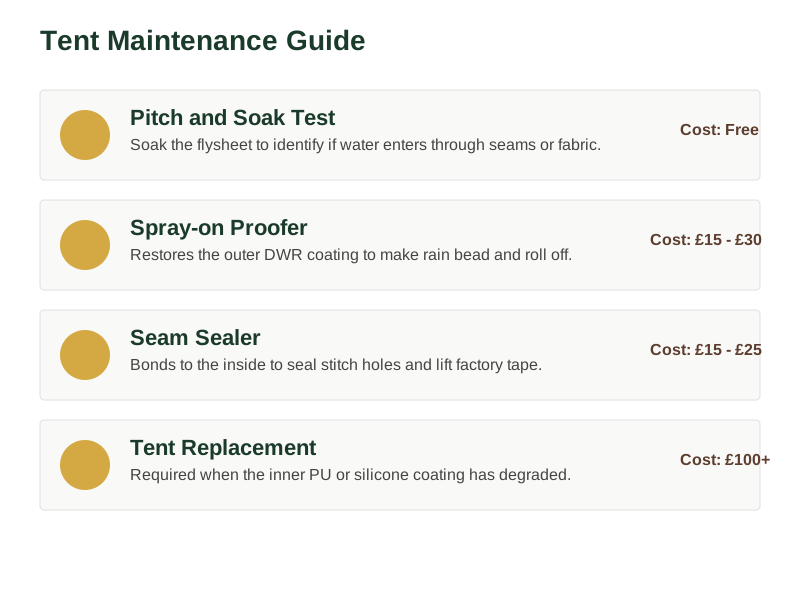
| Solution | Primary Function | Best For | Cost Estimate |
|---|---|---|---|
| Spray-on Proofer | Restores outer DWR coating | Wetting out face fabric | £15 - £30 |
| Seam Sealer | Seals stitch holes and tape | Leaks around seams | £15 - £25 |
| Pitch and Soak Test | Diagnostic step | Identifying the root cause | Free |
| Tent Replacement | Restores waterproof barrier | Degraded inner coating | £100+ |
| Ventilation | Prevents condensation | Dampness inside tent | Free |
This table offers general repair option comparisons. Always verify your tent’s specific condition before purchasing products.
Next Steps After Diagnosis
The pitch-and-soak test makes everything else fall into place, revealing whether you’re dealing with DWR refresh, seam seal, or tent reaching its waterproof lifespan. Products like Fabsil aerosol, Fabsil Gold concentrate, Gear Aid Seam Grip WP, and Nikwax Tent & Gear SolarProof become straightforward once you know which job they’re performing.
What spray-on proofer bottles cannot tell you is whether your tent has surface problems or structural ones. That distinction contains the entire answer. Obtain the Free Waterproof Care Checklist – it guides maintenance steps that keep tents sound longer, from first season through coating degradation signs.
Well-maintained tents don’t require reproofing every season. They need understanding of when problems involve seam tape versus coating – and acting on the correct one.
Related Guidance
For complete overviews, see our Tent Flysheet Leaking vs Condensation: How to Tell the Difference .
References
As an Amazon Associate we earn from qualifying purchases.
The information provided offers general guidance only. Always verify details with qualified professionals or official sources.