Softshell vs Hardshell: Care Differences You Need to Know
As an Amazon Associate we earn from qualifying purchases. Some links on this page are affiliate links, which means we may earn a small commission if you make a purchase.
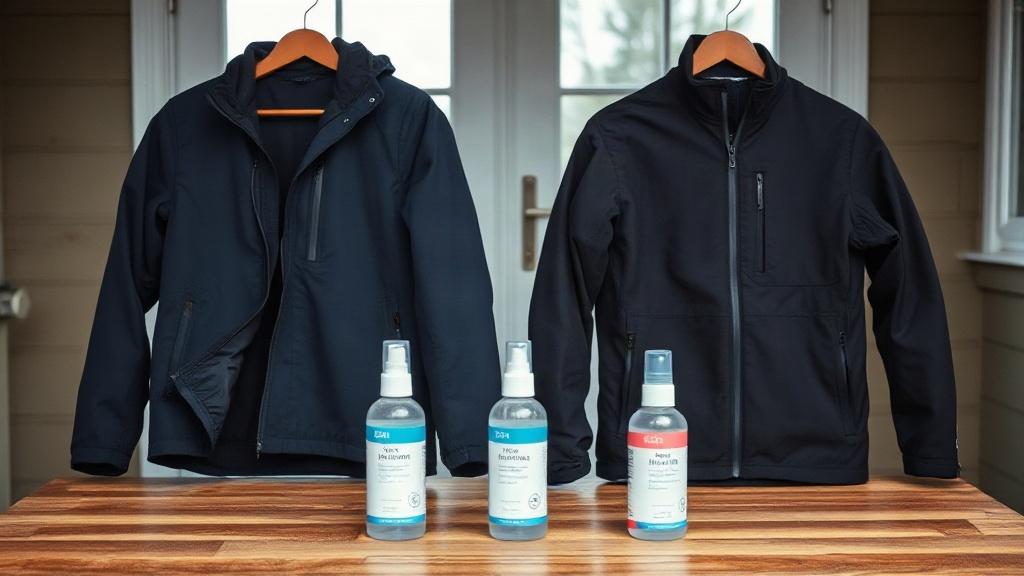
A softshell bonds stretch fleece directly to a DWR-treated woven face; a hardshell laminates a microporous membrane between face fabric and lining. This structural difference drives every care difference between them. Using the wrong cleaning method risks compromising the very properties that make each jacket work.
Most outdoor kit owners keep a bottle of wash-in proofer handy. When their jacket starts wetting out, they reach for it — but this approach can backfire on softshells. While it revives hardshells, the same product can damage softshell construction, reducing breathability and stretch.
Why Construction Dictates Care
Hardshells and softshells achieve weather protection through fundamentally different means, which explains their divergent care needs.
A hardshell relies on a layered system: a DWR-coated face fabric protects the waterproof membrane beneath. This membrane, whether ePTFE (like Gore-Tex) or PU, blocks liquid water while allowing vapour to escape. The face fabric can become saturated without compromising the membrane’s waterproofness.
Many softshells take a different approach. Instead of a separate membrane, they use a tight woven construction with elastane content for stretch. The fabric’s close fit helps seal out wind and moisture, with a light DWR treatment providing initial water beading. The waterproofing comes from the fabric’s mechanical properties rather than an added barrier layer.
These distinct material systems demand tailored maintenance routines. Applying hardshell care methods to softshells can permanently alter their performance characteristics.
For broader waterproof jacket guidance, see our waterproof jacket guide.
Softshell Maintenance: Wash Only
Softshell care focuses on preserving the fabric’s natural properties through gentle cleaning.
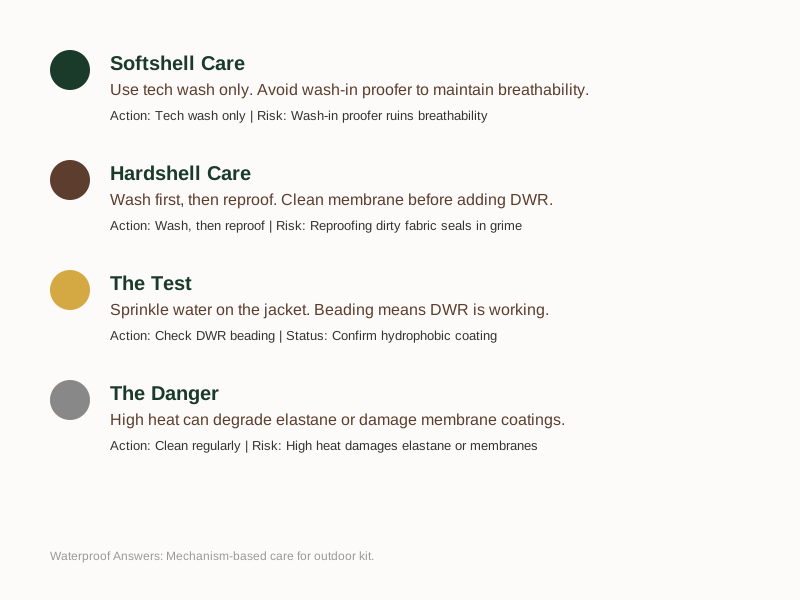
Use a dedicated tech wash like Nikwax Tech Wash (paid link) or Granger’s Performance Wash (paid link). These non-detergent formulas clean without leaving residues that could clog the fabric’s interstices. Run a cool synthetic cycle (around 30°C), secure all fasteners first, and avoid fabric softener entirely — its waxy coating reduces breathability in stretch fabrics.
Check Granger’s Performance Wash price → (paid link)
See Nikwax Tech Wash on Amazon → (paid link)
Air dry or use low heat tumble drying if permitted. Low heat helps maintain the face fabric’s fibre alignment, important for preserving the close fit. Ordinary laundry detergent leaves softening residues that can impair moisture movement and compromise the jacket’s stretch.
Avoid wash-in DWR proofer on softshells. While beneficial for hardshells, these products coat fibres with hydrophobic compounds that fill the gaps between threads. On softshells, this reduces breathability and can physically restrict elastane movement — compromising the very stretch that contributes to weather resistance.
If your softshell wets out, proper washing often restores performance. Dirt and oils commonly reduce water beading; removing them frequently reactivates existing DWR. If beading doesn’t return after cleaning, the DWR has worn off, but the solution remains careful washing rather than adding proofer that alters the fabric’s character.
Unsure which products suit your jacket? Our free checklist shows exactly what to use for different garment types.
The Reproofing Mistake
Applying hardshell care logic to softshells represents the most common maintenance error among UK outdoor enthusiasts.
Softshell water resistance depends partly on mechanical properties — the tight weave and stretch fit create a physical barrier. Wash-in DWR compounds sit between fibres, reducing breathability (a key softshell advantage) and potentially restricting elastane movement. The result: a stiffer, less breathable jacket that may wet out faster than before.
Hardshells avoid this problem because their membrane provides waterproofing independently of face fabric treatment. Applying DWR enhances water repellency without affecting the membrane’s function. This explains why Gore-Tex recommends regular washing followed by reproofing when beading diminishes.
Manufacturers emphasise proper sequence. Mountain Equipment states reproofing should only occur on clean garments, while Nikwax documentation stresses cleaning before reproofing. Reproofing dirty fabric seals contaminants in place, preventing proper DWR bonding.
The principle remains clear: softshells need washing alone; hardshells require washing then reproofing.
If your softshell wets out: wash with tech wash, air dry, and check if beading returns. If not, continue with gentle washing rather than reaching for hardshell proofer.
Hardshell Care: The Full Treatment
Hardshell maintenance requires a two-step process where sequence matters significantly.
Begin with tech wash — Nikwax Tech Wash (paid link) or Granger’s Performance Wash (paid link) — on a 30-40°C synthetic cycle. This removes grime, sweat and residues that accumulate on the membrane surface, impairing breathability. A clean membrane allows moisture vapour to escape effectively.
Reproof only after cleaning. Nikwax and Granger’s both emphasise this sequence — proofer applied to dirty fabric bonds to contaminants rather than fibres, yielding poor results.
For reproofing, consider Nikwax TX.Direct (paid link) (wash-in) or Granger’s Performance Repel. TX.Direct specifically targets waterproof breathable fabrics and receives manufacturer recommendations. Apply after washing, either via machine or spray (TX.Direct Spray-On for high-wear areas). Follow with low heat tumble drying to activate DWR bonding — warm air drying works but provides less thorough activation.
Check Nikwax TX.Direct price → (paid link)
Reproof when water stops beading on the face fabric, typically after heavy use or every few seasons. Test by sprinkling water on the jacket: beading indicates functioning DWR; absorption suggests reproofing needed.
Proper maintenance significantly extends membrane life at a fraction of replacement cost. For detailed proofer application methods, see our wash in vs spray on proofer guide.
Common Care Questions
Can I use ordinary detergent on waterproof jackets?
Avoid ordinary detergent. Formulated to leave fabrics feeling soft, these products deposit residues that reduce breathability and can degrade waterproofing over time. Dedicated tech wash cleans effectively without residue, extending jacket lifespan for minimal additional cost.
When should I reproof my hardshell?
Reproof when water no longer beads on the face fabric, typically after heavy use or seasonal wear. Don’t wait until the jacket feels wet inside — by then the face fabric saturates, creating evaporative cooling that mimics leaking even with an intact membrane.
Does tumble drying damage jackets?
Low heat tumble drying suits most modern membranes including Gore-Tex, and helps reactivate DWR. High heat risks damaging elastane in softshells or membrane coatings. Always follow care label instructions — if tumble drying isn’t recommended, air dry instead (with less complete DWR activation).
Essential Softshell Consideration
Softshell maintenance includes one crucial step with no hardshell equivalent: avoiding technical washes that strip the stretch-fleece backer’s loft. Unlike hardshells where reproofing restores performance, softshells depend on preserving their original fabric character through gentle cleaning alone.
Get the Free Waterproof Care Checklist
Further Reading
For membrane-specific guidance, see our Gore-Tex vs DWR vs Membrane: What You’re Actually Washing .
References
As an Amazon Associate we earn from qualifying purchases.
This guide provides general principles; always verify specific instructions with garment manufacturers.