Nikwax vs Granger's: Which Wash and Reproof Products Match Your Kit
As an Amazon Associate we earn from qualifying purchases. Some links on this page are affiliate links, which means we may earn a small commission if you make a purchase.
Both Nikwax and Granger’s sell four distinct product categories: technical wash, wash-in reproofer, spray reproofer, and down-specific wash. Most buyers compare one product from each brand — a wash versus a wash, a reproofer versus a reproofer — and miss that the real question is whether the system matches what their kit actually needs. This article fixes that framing problem.
Our Pick
- Gore-Tex or eVent membrane? Nikwax Tech Wash + TX.Direct — the pairing Gore-Tex itself recommends. Check Amazon price →
- Pertex, PU-coated, or budget shell? Granger's Performance Wash + Clothing Repel does just as good a job for less. Check Amazon price →
Why Your Waterproof Jacket Is Wetting Out
Before grabbing either bottle, it’s worth understanding what’s actually going on — because most wetting out isn’t a dead membrane. It’s a dirty face fabric.
The Durable Water Repellent (DWR) finish on a waterproof jacket is a thin chemical coating bonded to the outer face fabric. Its job is to make water bead and roll off rather than soak into the textile. When that coating gets clogged with body oils, outdoor grime, and — crucially — residue from ordinary household detergent, it stops working. Water then soaks into the face fabric, making the jacket feel wet from the outside even though the membrane underneath is probably still doing its job perfectly well.
The fix is straightforward: wash the jacket with a proper technical wash, let it dry, and check whether the beading has come back. If it has, no reproofing is needed. If the face fabric is still going dark when wet, then you apply a DWR treatment. Wash-in or spray-on is a separate choice; here’s when each one wins .
The mistake worth avoiding is reaching for the reproofing bottle first, without washing. That’s sealing the dirt in, and the order matters more than the product you pick . Another common error is using standard laundry detergent — it works against a waterproof : it strips the existing DWR and leaves its own residue behind, which is why the jacket often performs worse after a “clean” in the machine than it did when it was merely muddy. Check your membrane with a simple test: does water bead after a thorough wash? Yes → sorted. No → time to reproof or investigate further.
The Chemistry of Cleaning: Tech Wash vs. Performance Wash
Nikwax Tech Wash (paid link) and Granger’s Performance Wash do the same basic job — removing contaminants from technical fabrics without damaging the membrane or stripping away what’s left of the DWR — but they go about it differently.
View Nikwax Tech Wash on Amazon → (paid link)
Nikwax Tech Wash (paid link) is a non-detergent cleaner. It’s what Gore-Tex officially recommends: the two brands have a partnership agreement, and you’ll find Tech Wash listed on Gore-Tex’s own care guidance as the approved wash product for their membranes1. The formulation is built to avoid leaving residue on ePTFE (expanded polytetrafluoroethylene) membranes — the microscopic structure that makes Gore-Tex breathable. If any surfactant residue lingers on an ePTFE membrane, it can clog the pores and reduce breathability. Tech Wash is specifically engineered to prevent that.
Granger’s Performance Wash is also a technical cleaner and does a solid job on waterproof kit. But it uses a different surfactant system, one that performs well on PU-coated fabrics. The trade-off worth knowing is that on ePTFE membranes, it can leave residue if the rinse cycle isn’t thorough — not because it’s a bad product, but because the chemistry is slightly different. On PU-coated fabrics and non-membrane waterproofs (Pertex, for instance), this difference matters less.
So the short version: for a Gore-Tex or eVent jacket, Nikwax Tech Wash is the safer call because it’s formulated to avoid that residue problem on the membrane type most likely to be in your expensive shell.
The Verdict: Which System Should You Buy?
Here’s where it gets useful. Neither brand is objectively better — they win on different dimensions, and the right choice depends on your kit and your budget.
For Gore-Tex and eVent membranes: Nikwax Tech Wash + TX.Direct is the safer call. Gore-Tex recommends Nikwax products as part of its partnership agreement, and both are fluorocarbon-free. The mechanism here matters: because Nikwax has worked with Gore-Tex specifically, the surfactant system is designed to clean ePTFE membranes without clogging the breathable structure. That’s not a marketing claim — it’s the reason the endorsement exists. Current UK pricing shows Tech Wash around £5–10 and TX.Direct around £8–15 depending on retailer, so expect roughly £15–25 for the pair. It’s not cheap, but on a £300 Gore-Tex jacket, it’s insurance.
For Pertex and non-membrane waterproofs: Granger’s Performance Wash + Clothing Repel offers better value and a simpler two-bottle system. Granger’s typically comes in £2–4 cheaper per bottle than Nikwax equivalents at major UK retailers — Performance Wash often sits around £6.50–7.50, Clothing Repel around £8–10. It works well on PU-coated fabrics and synthetic waterproofs, and the surfactant chemistry is less of a concern when there isn’t an ePTFE membrane to protect. For a mid-range walking jacket or a budget shell that gets used hard and washed often, the saving adds up over a few seasons. If it’s the two reproofers you’re weighing up, Clothing Repel vs TX.Direct looks at which one lasts longer.
For budget-conscious users: a plain liquid soap for washing is genuinely fine — as long as you pair it with a separate reproof. Generic liquid soap removes detergent residue and grime without adding its own. It won’t restore DWR on its own, but neither will it wreck the face fabric the way ordinary laundry detergent does. Add a separate reproofing agent and you’ve got a functional system at the lowest cost.
System Comparison at a Glance
| Nikwax Tech Wash (paid link) + TX.Direct (paid link) | Granger’s Performance Wash (paid link) + Clothing Repel (paid link) | |
|---|---|---|
| Best for | Gore-Tex, eVent, ePTFE membranes | Pertex, PU-coated, budget shells |
| Why | Gore-Tex’s own recommended pairing; avoids ePTFE pore-clogging | Cheaper per bottle, works well on non-membrane fabrics |
| Typical cost (pair) | £15–£25 | £14.50–£17.50 |
| Fluorocarbon-free | Yes | Some products, not all |
One thing worth flagging: avoid 2-in-1 wash-and-reproof products from both brands. Combined products underperform compared with separate wash and proof steps. They’re convenient, yes — but the convenience comes at the cost of effectiveness, and on a jacket that’s already wetting out, you don’t want to trade effectiveness for convenience.
Now you know what to look for — Get the Free Waterproof Care Checklist to make sure you’ve got the right products and the right order of steps before you start.
Beyond Jackets: Down Gear and Tents
Nikwax and Granger’s both make products for down kit, and the difference between them is smaller here than it is with membrane jackets.
Nikwax Down Wash Direct (paid link) is recommended by Outdoor Research and cleans down effectively without clumping the plumage. Owners of down jackets and sleeping bags who use it report good loft restoration — the down gets clean without losing its insulating structure. Pair it with Nikwax Down Proof (paid link) to restore water repellency to the outer shell of a down jacket.
Check Nikwax Down Proof price → (paid link)
Check Nikwax Down Wash Direct price → (paid link)
Granger’s Down Wash (paid link) (300 ml) does a comparable job. Owner feedback suggests it’s similar in performance to Nikwax for down cleaning, and on price it’s competitive. For expensive down kit, either is worth using over standard detergent.
See Granger’s Down Wash on Amazon → (paid link)
For tents and awnings, Fabsil is the brand to reach for on a flysheet or awning. Use Fabsil aerosol 600 ml (paid link) for a spray.
Buy Fabsil aerosol 600 ml on Amazon → (paid link)
Fabsil Gold (paid link) (1 L concentrate) is paint-on, not a can. Nikwax and Granger’s clothing products are formulated with breathability in mind, which matters for membranes but isn’t the priority for a tent.
Check Fabsil Gold price → (paid link)
From Product Systems to Kit-Specific Action
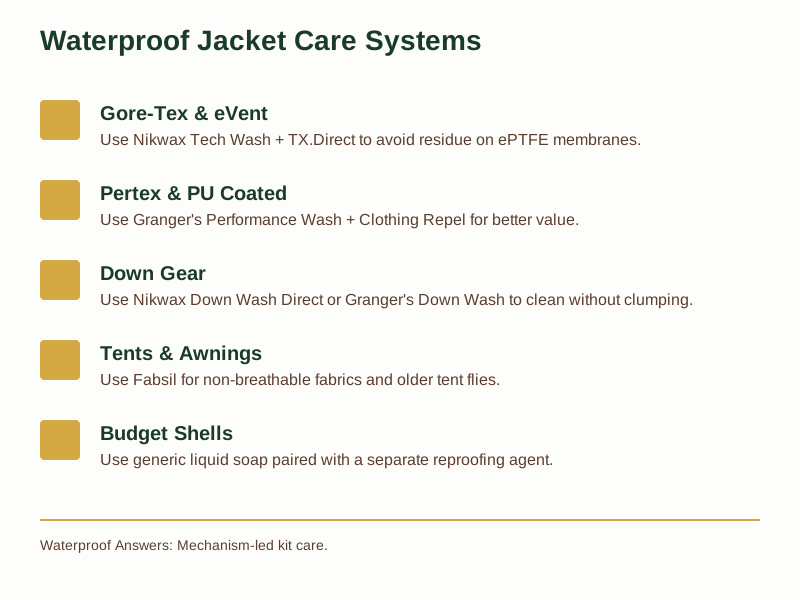
Here’s the mapping: hardshell membranes (Gore-Tex, eVent) → Nikwax Tech Wash + TX.Direct; softshells and PU-coated fabrics → Granger’s Performance Wash + Clothing Repel; down insulation → either brand’s down-specific wash; tent fabrics → Fabsil. That’s your one-line decision per category.
The portable version of this mapping is the Free Waterproof Care Checklist — it walks you through identifying your kit type, choosing the right system, and sequencing the steps correctly.
Frequently Asked Questions
Can I use regular laundry detergent on my waterproof jacket?
No — and it’s the most common mistake people make. Regular detergent is formulated to leave surfactants behind for a soft feel and fragrance. Those residues sit on the face fabric, strip the remaining DWR, and can clog membrane pores. A technical wash like Nikwax Tech Wash or Granger’s Performance Wash is formulated to clean without leaving that residue behind.
Do I need to reproof my jacket every time I wash it?
Not every time. Most modern DWR finishes hold up through several washes before they need refreshing. The rule is simple: wash first, let the jacket dry, then run the bead test with cold water from a tap. If water beads, you’re done. If it soaks in and darkens the fabric, time to reproof.
Is Nikwax or Granger’s better for the environment?
Nikwax has a cleaner profile here — both Tech Wash and TX.Direct are fluorocarbon-free2, which is the direction the outdoor industry is moving. Granger’s offers some fluorocarbon-free products, though not all items in their range carry this designation. If environmental credentials are a priority, Nikwax is the more straightforward choice.
Can I put my waterproof jacket in the tumble dryer?
It depends on the garment. Check the care label — some Gore-Tex jackets can be tumble dried on a low heat to help reactivate the DWR, and a condenser dryer on a gentle cycle is fine for most technical shells3. Some ultralight jackets and down-filled garments must not go in the dryer at all. When in doubt, line dry and apply low heat with an iron on the “no steam” setting if the care label allows it. And if the care label and the product bottle tell you different things, here’s why brand care cards disagree .
As an Amazon Associate we earn from qualifying purchases.
GORE-TEX care guidance lists Nikwax Tech Wash as recommended. Source: https://www.gore-tex.com/support/care/outerwear ↩︎
Nikwax environmental position states products are fluorocarbon-free. Source: https://www.nikwax.com/en-gb/about-us/our-environmental-credentials/ ↩︎
GORE-TEX care instructions recommend tumble drying on warm gentle cycle or line drying to reactivate DWR. Source: https://www.gore-tex.com/support/care/outerwear ↩︎