Nikwax Tech Wash vs Ordinary Detergent: Which Cleans Best?
As an Amazon Associate we earn from qualifying purchases. This page contains affiliate links — if you buy through them, we earn a small commission at no extra cost to you.
Standard laundry detergents rely on anionic surfactants — molecules with a negative electrical charge that excel at pulling oils and grime from cotton fibres. The trouble is that same charge does not discriminate: it attacks the fluorocarbon bonds holding DWR to your jacket’s face fabric. Nikwax Tech Wash uses non-ionic surfactants instead — no electrical charge, so they encapsulate dirt without disturbing the waterproof coating. That structural difference is why one cleaner preserves your gear and the other slowly destroys it.
By the end of this piece, you’ll know why ordinary detergent attacks waterproof gear, what a technical cleaner actually does, and which one to reach for.
Our Pick
- Have a Gore-Tex, eVent or membrane jacket? Use Nikwax Tech Wash — ordinary detergent strips the DWR coating a little more with every wash. Check Amazon price →
- Cheap non-membrane shell you don't mind wearing out? Ordinary detergent is genuinely fine.
Why Your Waterproof Jacket Feels Wet Inside
The face fabric of a waterproof breathable jacket is coated with a thin chemical layer called DWR — Durable Water Repellency. This is a fluorocarbon finish bonded to the outer fibres of the fabric. Its job is simple: make water bead and roll off rather than soaking into the textile. When DWR is working, rain hits the surface and spheres away. The membrane underneath does its job of blocking liquid water while allowing vapour (your sweat) to escape. You stay dry.
When DWR fails — or was never there in sufficient quantity to begin with — water soaks into the face fabric instead of beading off. The garment looks dark and wet. Because the face fabric is saturated, it cannot evaporate moisture efficiently. Your sweat has nowhere to go, so you feel damp and clammy even though the jacket is technically still waterproof underneath. This pattern — a dark, soaked face fabric within twenty minutes of rain — is the classic DWR failure signature, not a dead membrane.
The stakes here are real. If the outer fabric absorbs water, the garment can lose a significant proportion of its breathability, which is why wet-out jackets feel so much more uncomfortable than they did when they were new. Most of this performance loss is a maintenance issue, not a product failure — the membrane will often outlast the DWR by a long way. That is good news: it means you can fix it yourself.
The Chemistry of the Wet-Out
This is the bit that matters most, so it is worth spending a moment on the mechanism.
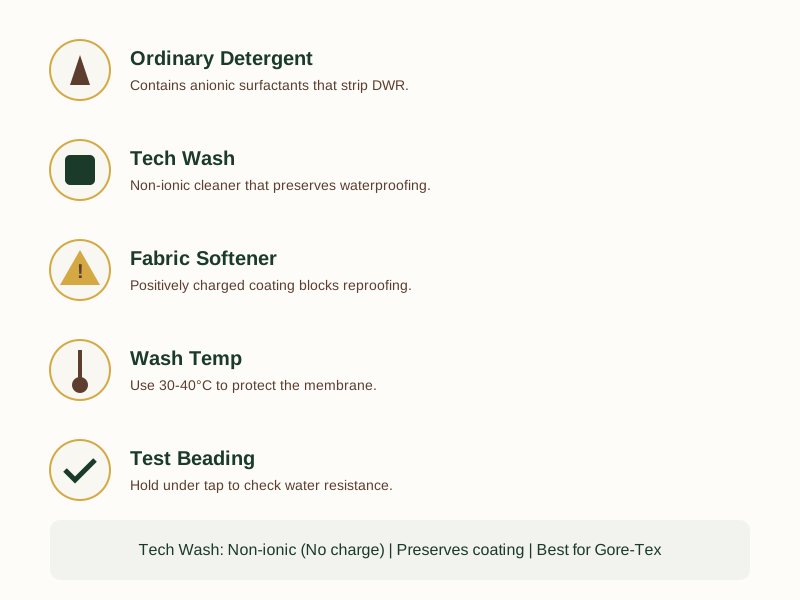
Ordinary laundry detergent is formulated with anionic surfactants — molecules with a negative electrical charge. Anionic surfactants are excellent at lifting oils, body fats, and general grime from fabrics, which is exactly what you want for a cotton t-shirt. The negative charge breaks down oily residues and holds them in suspension so the wash water carries them away. The problem is that these same charged molecules do not distinguish between the dirt on your jacket and the fluorocarbon molecules bonded to your jacket’s face fabric. They attack the DWR bond indiscriminately. Over repeated washes, the DWR coating is stripped away. Once it is gone, water soaks the face fabric freely — and the jacket wets out on every rainy walk.
Nikwax Tech Wash (paid link), by contrast, is a non-ionic cleaner. Non-ionic surfactants carry no electrical charge. Instead of aggressively pulling at the fabric surface, they surround dirt particles and encapsulate them, lifting them away without disturbing the chemical bonds holding the DWR to the fibres. The DWR stays in place; the grime goes. That is the core difference — one cleaner removes dirt and damages the waterproofing in the same cycle; the other removes dirt and leaves the waterproofing intact.
Check Nikwax Tech Wash price → (paid link)
The picture gets worse if fabric softener enters the equation. Fabric softener is cationic — positively charged — and it works by coating fibres to make them feel smoother. That coating actively repels any subsequent DWR treatment you apply afterwards, meaning that if you have used fabric softener on your waterproof jacket, a wash-in reproofer may struggle to bond to the fabric at all. You would need to run a couple of pure tech-wash cycles first to strip the residue. Nobody puts “may require two extra washes to fix the softener damage” on the care card, but that is the honest situation.
Nikwax’s own product description calls Tech Wash a technical cleaner designed specifically for waterproof and breathable clothing, and it explicitly advises against using conventional detergent on treated fabrics. Gore’s care guidance similarly specifies avoiding powder detergent, softener, and bleach on their membrane garments1. The reason both manufacturers say this is not to sell more bottles — it is that they know exactly what anionic surfactants do to a fluorocarbon DWR finish over time.
So: ordinary detergent is a cleaner that quietly destroys your jacket’s water resistance with every wash. Tech Wash is a cleaner that removes the grime without touching the DWR. That is the mechanism. Once you see it, the choice for expensive Gore-Tex gear becomes straightforward.
It is important to note that Tech Wash is a cleaner — it removes dirt and grime without damaging the existing DWR coating. It does not add any new water-repellent finish. If your jacket is no longer beading water after washing, you need a separate DWR treatment product applied after the clean cycle. Nikwax TX.Direct (paid link) is the companion product designed for this. The choice between wash-in and spray-on reproofing is also relevant: wash-in reproofers coat the entire garment evenly during a wash cycle — good for full-jacket treatment. Spray-on reproofers (like TX.Direct Spray-On) let you target specific worn areas like the shoulders and hood where DWR tends to go first. Wash-in gives thorough coverage; spray-on suits targeted touch-ups without treating the whole garment.
Check Nikwax TX.Direct price → (paid link)
When to Use What: A Cost Breakdown
Here is where we get to the actual decision you are making at the sink.
Ordinary detergent wins on price — it is already in your cupboard, it costs pennies per wash, and for a cotton rain jacket you don’t care much about, it genuinely does not matter. For a cheap unlined shower-proof shell with no membrane to protect, the risk is low.
Nikwax Tech Wash (paid link) wins on performance. It cleans your expensive waterproof kit without attacking the DWR layer, preserves breathability, and — when paired with a reproofer if needed — keeps your £300 jacket performing the way it should. Price varies by retailer and bottle size; check current listings. That is not a large outlay against a jacket that would otherwise need replacing.
The honest trade-off is this: for any jacket or pair of overtrousers where the waterproofing actually matters — Gore-Tex, eVent, any membrane or membrane-free breathable — Tech Wash is the correct choice, and the price difference is negligible compared to the cost of replacing the garment. Buy the bottle. Use it instead of your regular detergent on those items. Sorted.
If you want a budget alternative, Granger’s Performance Wash (paid link) occupies a similar niche and is often used interchangeably by owners who find it effective for routine cleaning of technical fabrics. The community notes suggest it is particularly common among motorcycle and outdoor users who appreciate the local availability. It does not restore the factory-level DWR finish, but for regular maintenance between deeper reproofing treatments, it does the job.
Check Granger’s Performance Wash price → (paid link)
One thing worth knowing: owners who pair Tech Wash with a separate DWR treatment like Nikwax TX.Direct (paid link) tend to report the best long-term results. Tech Wash cleans the fabric; TX.Direct replenishes the water-repellent coating. Using them as a two-step process — wash, then reproof if the jacket still does not bead after drying — is the standard maintenance approach that most care guidance recommends. Tech Wash on its own does not add DWR; it only protects what remains.
How to Wash Waterproof Kit Properly
Washing your waterproof kit at home is worth doing regularly — grime itself degrades DWR performance, not just the wrong soap. A few basics are worth getting right.
Use a dedicated technical cleaner and use a small amount. The bottle instructions will tell you the right dose — you do not need more than that. More detergent leaves more residue, and residue is what you are trying to avoid. Wash on a 30–40°C cycle. Nikwax and Gore both specify around 40°C for membrane garments2. That is a cool cycle by ordinary laundry standards, but heat is what can stress the membrane and the seam tape over time, so the lower temperature is the right call. Rinse thoroughly — an extra rinse cycle is a good idea to make sure nothing lingers.
Avoid fabric softener and bleach in any circumstances. We covered the softener issue above, and bleach is obviously destructive to coloured and membrane fabrics alike. Stain removers are similarly unnecessary and potentially harmful to the coating.
After washing, check whether the jacket is beading water. Hold it under a tap, let it dry naturally, and see if droplets sit on the surface or soak in. If the fabric still absorbs water after a proper tech-wash clean and a full dry, the DWR has been depleted past the point that cleaning alone can restore — at which point a wash-in reproofer like TX.Direct is the next step.
Wash frequency depends on use. After heavy soiling or a muddy winter walk, clean it before grime dries in and sets. Dirt fills gaps between fibres and breaks down the water-repellent coating, which is why a jacket that looks dirty will always perform worse than a clean one, even if the DWR has not been stripped chemically.
Now you know what to look for — Get the Free Waterproof Care Checklist to make sure you are doing this in the right order every time.
Detergent Chemistry Comparison
| Feature | Ordinary Detergent | Nikwax Tech Wash (paid link) |
|---|---|---|
| Surfactant Type | Anionic (Negatively charged) | Non-ionic (No charge) |
| Effect on DWR | Strips and damages coating | Preserves existing coating |
| Primary Function | General cleaning | Technical fabric cleaning |
| Fabric Softener | Can be used | Should be avoided |
| Best For | Cotton t-shirts | Gore-Tex and membranes |
Where to Go From Here
Ordinary detergent is acceptable for one scenario only: a lightly soiled softshell with no membrane, where waterproofing was never the priority. For any laminated membrane shell — Gore-Tex, eVent, or similar — it is the wrong choice. The surfactant chemistry strips DWR, accelerates wet-out, and shortens the usable life of expensive kit.
Use a technical cleaner on your membrane kit. Wash it regularly. If it still does not bead after a clean and dry, reproof it. That is the sequence that keeps expensive waterproof gear working for years rather than one season.
Not sure where your current jacket sits? Grab the Free Waterproof Care Checklist — it walks through the product-selection logic step by step, so you match the right cleaner and reproofer to what you actually own.
Related Guides
As an Amazon Associate we earn from qualifying purchases.
Note: General guidance only, verify details with a qualified professional or official source.
GORE-TEX care guidance specifies avoiding powder detergents, fabric softeners, and bleach. Source: https://www.gore-tex.com/support/care/outerwear ↩︎
GORE-TEX care instructions recommend warm (40°C/104°F) washing. Source: https://www.gore-tex.com/support/care/outerwear ↩︎