Does Tumble Drying Actually Reactivate DWR?
As an Amazon Associate we earn from qualifying purchases. This page contains affiliate links — if you buy through them, we earn a small commission at no extra cost to you.
When your waterproof jacket stops beading after a wash, the immediate question is whether drying it will bring back that water-shedding magic. But there are actually two separate jobs here: removing moisture from the garment, and reactivating its water-repellent finish. Tumble drying handles the first perfectly—it’s the second claim that needs examining.
That brief revival you sometimes see is what this article tackles. The dryer does something to DWR, but it isn’t regeneration. Understanding the distinction means the difference between a jacket that keeps you dry through proper maintenance and one you replace prematurely.
When Wetting Out Signals DWR Loss
Wetting out occurs when your jacket’s outer fabric stops shedding rain. Instead of beading and rolling off, water spreads and soaks through. Your shoulders darken and feel cold, while the rest might seem fine—that pattern points to the DWR finish failing, not the membrane beneath.
The confusion stems from wetting out feeling exactly like a leak. You’re getting wet, so something must have failed. Yet the actual waterproof layer is often still intact. What’s failed is the Durable Water Repellent finish applied during manufacture. This thin chemical coating makes rain bead up. Without it, the outer fabric absorbs water like a sponge, and once saturated, evaporative cooling makes the whole jacket feel damp even though the membrane remains waterproof.
This distinction matters because many people assume their jacket has “died” and buy a replacement when proper reproofing would have restored it. Washing accelerates wetting out in a specific way: detergent and body oils strip the DWR coating along with dirt. Cleaning is necessary—a dirty DWR won’t bead either—but the process also removes hydrophobic molecules. What happens after that wash determines whether you get a temporary fix or a lasting solution.
What Heat Actually Does to DWR
The common belief is that tumble drying reactivates DWR—that heat restores it to life. Care labels often reinforce this idea.
The real mechanism is more about redistribution than reactivation. During manufacture, DWR molecules migrate to the fabric surface and bond there. Over time, wearing and washing knock these molecules off—they abrade away or get pulled out. Tumble drying heats the fabric to a point where any remaining DWR molecules can reorient and spread across the surface, filling gaps left by lost molecules. You’re not repairing the coating; you’re optimising what remains.
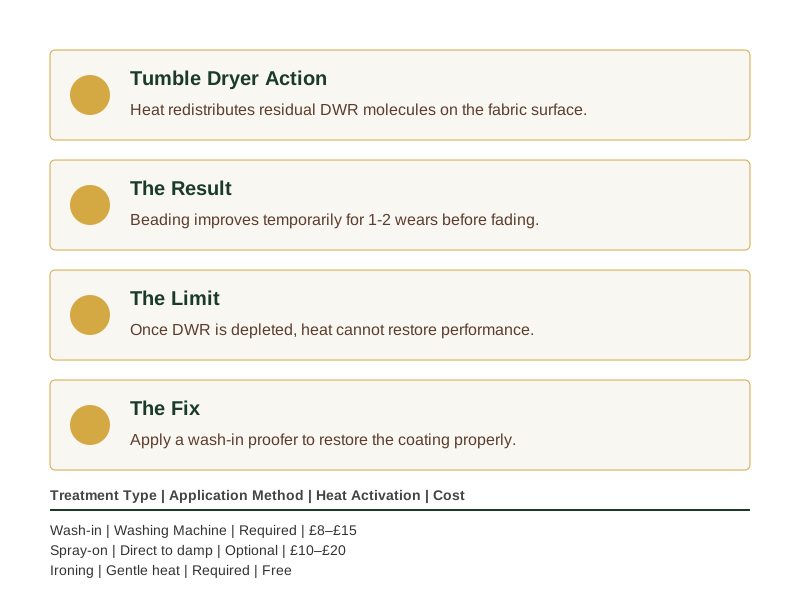
The practical consequence is clear: heat redistributes residual DWR molecules temporarily improving beading. This effect is short-lived, fading after a few wears once the limited reservoir of molecules wears thin again.
Gore-Tex’s care guidance illustrates this balance. Their instructions state that tumble drying for 20 minutes after the garment is dry “reactivates the durable water-repellent treatment.” Yet the same document acknowledges that if water no longer beads after washing and drying, you’ll need to reapply DWR. The brand that sells the jackets admits the limitation alongside the recommendation.
The trade-off sits in plain sight: heat works on what’s left. Once the coating is sufficiently depleted, heat has nothing meaningful to redistribute.
The Redistribution Mechanism Explained
Tumble drying does not chemically reactivate DWR—it physically redistributes residual DWR molecules on the fabric surface, which can temporarily improve beading but does not replace lost DWR. Only a new proofer application restores full performance.
Here’s how it works: DWR molecules sit on the outer face fabric providing hydrophobic properties. Every wash loosens some molecules; body oils and detergent residue interfere with those remaining. Tumble drying applies heat—typically low heat for around 20 minutes—which softens the remaining DWR allowing it to flow and reorient. Molecules spread into gaps, the surface becomes more uniformly hydrophobic, and beading returns.
What it cannot do is manufacture new DWR molecules. If the original coating has been substantially worn away—after years of hard use or repeated washes without reproofing—no heat redistribution will fix it. You need new chemistry on the fabric, which is what wash-in or spray-on proofers deliver.
The practical threshold most owners discover is straightforward: if you wash your jacket, tumble dry it, and water beads perfectly, then wear it twice in the rain and it wets out again, the DWR wasn’t restored. Redistribution of remnants occurred, but the coating is gone. Tumble drying won’t bring it back.
This understanding informs the correct maintenance sequence: wash first, dry with heat to test for residual DWR, and only then apply a reproofer if beading doesn’t return. The heat step is both diagnostic and curative. It reveals how much work the proofer needs to do. If the jacket beads after drying, no reproofing is needed yet. If it still wets out, DWR is gone and reproofing becomes essential.
When Redistribution Fails: Reproofing Properly
When heat redistribution fails, the solution is a new DWR application. Not a spray-on over a dirty jacket—that wastes product—but a proper wash-then-reproof sequence.
A wash-in proofer like Nikwax TX.Direct (paid link) or Granger’s Clothing Repel (paid link) introduces new hydrophobic molecules into the fabric during a wash cycle. Heat activation—tumble drying afterwards—helps these molecules bond properly to fibres. The result isn’t a temporary patch but a restored coating.
Check Granger’s Clothing Repel price → (paid link)
Check Nikwax TX.Direct price → (paid link)
Nikwax’s guidance confirms this approach: they recommend tumble drying as their wash-in DWR treatment is heat activated. That’s the crucial combination—not heat instead of proofer, but heat as part of the proofer application.
Users who follow this process find the improvement is noticeable and durable, often lasting through regular use before another wash-and-reproof cycle becomes necessary. The common observation with both Nikwax and Granger’s products involves the distinctive smell—a small trade-off compared to replacing a £200-plus jacket.
For the complete walkthrough of the wash-then-reproof process, see our guide at How to Reproof a Waterproof Jacket.
Drying Options Without a Tumble Dryer
Not every household has a tumble dryer. Flats, rented accommodation, and older properties often lack this appliance. The question becomes whether you can achieve similar results through other means.
Air drying works fine for cleaning but doesn’t redistribute DWR—without heat, residual molecules don’t reorient. It’s not harmful though, and remains the right first step: wash the jacket, let it dry, assess beading. If wetting out persists, you know where you stand.
Ironing offers an alternative when no dryer is available. Using an iron on a gentle setting—no steam—can provide enough heat to redistribute residual DWR. The critical caution is to avoid steam and never iron directly on the fabric without a protective cloth between iron and garment. Steam risks damaging the membrane, and direct heat could affect coatings or seam tape bonding. Handled carefully, it’s a functional workaround.
Air-curing reproofing options also exist—products that don’t require heat activation at all, sidestepping the dryer problem completely. If you lack a dryer and prefer avoiding ironing fuss, a spray-on proofer applied to a damp garment and left to cure at room temperature provides a practical route. It requires more time but works effectively.
Common DWR Questions Answered
Can I safely tumble dry my waterproof jacket?
Yes, after washing. Use a low heat setting for around 20 minutes—matching the duration Gore-Tex specifies. High heat risks damaging components, so stick to gentle cycles. Once dry and cool, test beading by splashing water on the fabric.
Will tumble drying resolve wetting out?
Only temporarily, and only if residual DWR remains on the fabric. Heat redistributes what’s left; it doesn’t replace what’s gone. If the jacket wets out after drying, DWR is depleted and reproofing is needed.
What’s the most effective reproofing method?
A wash-in proofer applied to a clean garment, followed by tumble drying to heat-activate. Nikwax TX.Direct (paid link) and Granger’s Clothing Repel (paid link) are widely used options. Apply to a freshly washed jacket, run through the machine on appropriate settings, then tumble dry on low heat to cure the coating.
Can a hair dryer reactivate DWR?
Not effectively. Hair dryers don’t provide even, sustained heat distribution like tumble dryers. Holding one close enough long enough becomes impractical, and uneven heat risks damaging fabric spots. The iron method works better when no dryer is available.
How frequently should I reproof my jacket?
No fixed schedule exists—it depends on wear frequency, usage intensity, and when beading stops working. A practical approach is checking beading every few months during wet season, or whenever the jacket feels wetter than it should. If it wets out after washing and drying, it’s time.
Your Jacket’s Care Routine Reference
Think of tumble drying as part of your garment’s heat-setting and drying-stage routine—useful for extending a coating that still has life, and diagnostic for determining when that life has ended. Once a jacket wets out after proper drying, the message is clear: DWR is gone, and only reproofing restores it.
If your jacket’s membrane remains functional—as most wetting-out jackets’ do—then a bottle of wash-in proofer costs far less than replacement. The honest trade-off sits between modest effort and fluid cost versus the price of new kit.
The maintenance sequence matters: wash first, dry with heat, assess. Only reproof if beading doesn’t return. Following this pattern keeps well-made waterproof jackets performing years beyond when many assume they’re finished.
For a clear reference placing your jacket within this cycle, Get the Free Waterproof Care Checklist —covering wash-dry-reproof sequences for common membrane and DWR systems.
Further Reading
For complete technical background, see our Gore-Tex vs DWR vs Membrane: What You’re Actually Washing .
Reference Sources
As an Amazon Associate we earn from qualifying purchases.
Note: General guidance only, verify details with a qualified professional or official source.