Why Brand Care Cards Disagree: The Truth About Manufacturer Wash Instructions
As an Amazon Associate we earn from qualifying purchases. This page contains affiliate links — if you buy through them, we earn a small commission at no extra cost to you.
A Gore-Tex jacket care label might recommend washing at 40°C with Grangers Performance Wash, while a Berghaus shell suggests 30°C with their own Revivexx product. Both garments use similar membranes and DWR coatings, yet the guidance conflicts. Which temperature and brand combination is actually correct?
The reality is that both approaches work when using proper technical cleaners. The divergence stems from commercial arrangements rather than chemical requirements. Care labels function as marketing tools pointing toward each brand’s retail offerings, not as definitive chemical specifications.
This explains why you’ll find contradictory advice across different outdoor brands’ care instructions. The core chemistry of waterproof fabric maintenance remains consistent regardless of whose name appears on the bottle.
Understanding DWR Failure
When waterproof jackets stop performing, the issue typically lies with the DWR (Durable Water Repellent) coating rather than the membrane itself. According to Gore-Tex’s care guidance, DWR is a treatment applied to the outer fabric that causes water to bead up and roll off. When this coating becomes contaminated with body oils, sweat, or dirt, water soaks into the face fabric — a condition known as “wetting out” — even though the waterproof membrane beneath remains functional.
The solution involves proper cleaning to restore DWR effectiveness. Standard laundry detergents create problems because they contain softeners and additives designed for everyday fabrics. Gore-Tex specifically advises against using fabric softeners, stain removers, and powder detergents as they can leave residues that impair water repellency. Technical washes like Nikwax Tech Wash (paid link) or Granger’s Performance Wash (paid link) clean without these problematic additives.
Check Nikwax Tech Wash price → (paid link)
Our waterproof jacket care guide provides detailed diagnosis steps if you’re uncertain whether your jacket needs cleaning, reproofing, or both.
Commercial Motivations Behind Care Labels
Outdoor brands have financial incentives to recommend their own care products. When a Rab jacket suggests using Rab Reproof or a Berghaus garment specifies Revivexx, this reflects retail strategy rather than unique chemical requirements. These recommendations originate from marketing departments, not laboratory testing that proves incompatibility with other technical washes.
Gore-Tex’s published care instructions take a different approach, focusing on the cleaning process rather than brand specificity. Their guidance emphasises regular washing, proper drying to reactivate DWR, and reapplying water-repellent treatment when beading diminishes — without mandating particular product brands.
Nikwax’s technical information similarly focuses on process over brand loyalty. They describe Tech Wash as a cleaner and TX.Direct as a reproofer, with the application sequence mattering more than the garment manufacturer.
The Chemistry Behind Technical Washes
Technical washes from major brands share fundamental cleaning principles despite different branding. The active ingredients in products designed for waterproof fabrics work similarly to remove contaminants without compromising DWR coatings. While formulations may vary slightly between manufacturers, the core functionality remains consistent across reputable technical cleaning products.
What matters most is using a wash specifically designed for technical fabrics rather than ordinary detergent. These specialised cleaners avoid the residues that impair water repellency. The brand name on the bottle becomes secondary to this fundamental requirement.
Using Granger’s Performance Wash (paid link) on a Rab jacket or Nikwax Tech Wash (paid link) on a Berghaus shell presents no technical risk when both products are designed for similar membranes. The critical factors remain thorough cleaning, proper rinsing, and appropriate drying — usually involving low-to-medium heat to help redistribute remaining DWR.
Check Granger’s Performance Wash price → (paid link)
Warranty concerns often prove unfounded. Most manufacturers cover defects in materials and workmanship rather than user error from using alternative technical washes. Damage from improper care like using bleach or excessive heat would void warranties, but using a different reputable technical cleaner typically doesn’t constitute improper care.
Effective Maintenance Sequence
The brand of cleaning product matters less than following the correct maintenance sequence. Focus on these three elements:
Proper cleaning comes first. Use a technical wash specifically formulated for waterproof fabrics. Avoid ordinary detergents, fabric softeners, and biological washes with enzymes that might affect membrane coatings. An extra rinse cycle ensures complete removal of cleaning residues.
Drying reactivates DWR. Tumble drying on low-to-medium heat helps redistribute the remaining water-repellent coating. If tumble drying isn’t possible, hanging in a warm, well-ventilated area provides the next best option. Avoid draping wet jackets over radiators, which can cause uneven drying and reduced DWR effectiveness.
Reproof only when necessary. Not every wash requires reproofing. If water beading returns after proper cleaning and drying, additional treatment isn’t needed. When the face fabric continues absorbing water despite correct cleaning, apply a reproofer like Nikwax TX.Direct (paid link) or Granger’s Repel. The DWR chemistry in these matches the performance of most brand-specific alternatives. Exceptions exist for specialised membranes with genuine compatibility requirements, but standard Gore-Tex and similar fabrics work well with any reputable wash-in DWR product. Spray-on versions work well for targeting high-wear areas without treating the entire garment.
Check Nikwax TX.Direct price → (paid link)
Heavily worn DWR coatings on areas like shoulders and cuffs may not fully restore to factory condition through home reproofing. At this point, consider whether continued reproofing provides sufficient performance or if replacement makes more sense.
For detailed comparisons between independent brands, see our Nikwax vs Granger’s analysis.
Common Care Label Misinterpretations
The most damaging misreading of care labels involves treating brand recommendations as chemical requirements rather than commercial suggestions. This misunderstanding leads outdoor enthusiasts to overspend on branded products without technical justification.
The correct interpretation recognises that care labels specify minimum standards — using technical washes rather than ordinary detergents — while the specific brand matters less than proper application technique. Reputable technical cleaners from established manufacturers provide equivalent performance regardless of whose name appears on the garment’s label. Crucially, you should avoid using ordinary laundry detergent, as standard detergents contain ingredients that leave residues on technical fabrics, reducing water repellency. Technical washes clean without these problematic additives. If you’ve used regular detergent and notice reduced beading, a proper technical wash followed by correct drying often restores performance without needing reproofing.
Now you understand how to interpret care instructions correctly — download our Free Waterproof Care Checklist to maintain your gear effectively.
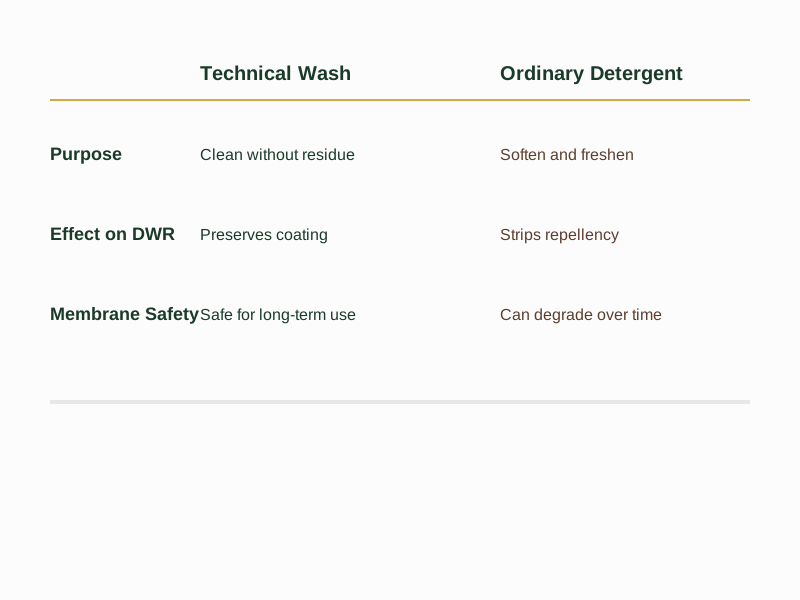
| Cleaning Approach | Effect on Waterproof Fabrics |
|---|---|
| Technical Wash | Cleans without compromising DWR |
| Ordinary Detergent | Leaves residues that impair water repellency |
Care label confusion serves commercial interests by encouraging ongoing purchases of branded maintenance products. The technical reality is simpler: use proper cleaning techniques with any reputable technical wash, dry correctly, and reproof only when necessary. This approach maintains performance regardless of whose name appears on the care label.
Get the Free Waterproof Care Checklist to implement these principles effectively and extend your jacket’s functional lifespan.
Related Guides
For complete technical comparisons, see our Nikwax vs Granger’s: Which Wash and Reproof Products Match Your Kit .
Sources & Further Reading
As an Amazon Associate we earn from qualifying purchases.
Note: General guidance only, verify details with a qualified professional or official source.